
SESSION THREE: WHERE DO OTHER TYPES OF THINKING FIT IN?
There are different approaches to research about how people think and how our brains work. If you think about you and your best friends, you probably don’t all approach things the same way, even if you come up with the same results.
In this session, you’ll learn about left and right brain thinking and explore the concept of whole brain thinking.
Left- and Right-Brain Thinking
The concept of different characteristics for the left and right brain was explored and explained by scientist Roger Sperry. His theory can be summed up in his own words: “The great pleasure and feeling in my right brain is more than my left brain can find the words to tell you.”
| Left-Brain Thinkers… | Right-Brain Thinkers… |
| o Work with words | o Work with images |
| o Prefer to talk and write | o Prefer creative methods of expression, such as drawing and music |
| o Think logically and sequentially | o Think intuitively |
| o Control feelings | o Allow feelings to affect their lives |
| o Look for differences | o Look for commonalities and patterns |
| o Are planned and structured | o Are spontaneous and random |
| o Are objective | o Are subjective |
| o Look at the parts | o Look at wholes and think holistically |
Think of it this way: with only the left side of your brain, you would be able to read the word “snow” but you wouldn’t be able to picture it.
Whole-Brain Thinking
The whole-brain model was developed by Ned Hermann in 1979. It outlines four thinking styles.
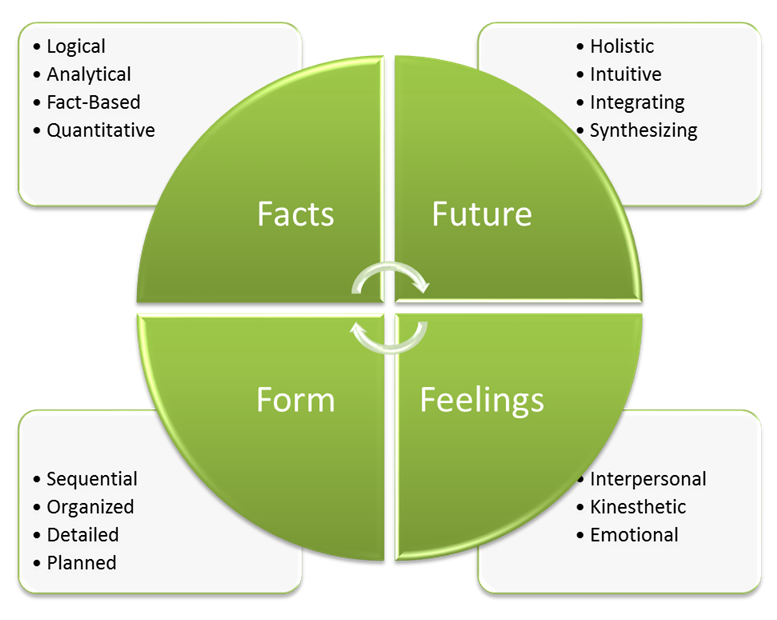
(Source: The Whole Brain Business Book, Ned Hermann)
We can use this model as a checklist to ensure we’re covering all the bases and thinking critically.