SESSION EIGHT: SCHEDULING
Along with setting goals, planning, setting priorities, making decisions and delegating, scheduling is intrinsic to competently managing your time.
In this session, you will learn how to organize your time through estimating how long it will take to complete tasks and then how to apply this knowledge to create a schedule.
Organize Your Time
If you are receiving tasks and assignments by email, or your boss delegates assignments to you, make sure you organize these incoming items immediately. If something will take more than 30 minutes to complete, schedule it in your calendar and prioritize the items there. If the task will take less than 30 minutes, try to get it done right away so that you are not procrastinating over it, or do not forget that it needs doing.
Estimating Tips and Techniques
The following information relates to managing a project, but is also applicable to organizing time in general.
There are various types of time estimating techniques that you can use, depending on the stages of, and information you have, for a given project. For example, you might have just completed your work breakdown structure when your boss asks you for a project cost estimate. Depending on how quickly the turnaround requirement is for the number, this could be a good or fair estimate. Or, your boss may ask you how long it would take to complete a project similar to one you worked on last year. In either case, the type and quality of the estimate you provide is directly related to the information you have and are able to receive.
The main thing to remember when putting together a time estimate, regardless of how preliminary, is to list all assumptions and factors that you considered. Listing your assumptions and factors lets the reviewer know what your calculations were based on, and also provides a base for estimate comparison.
Gathering Resources
Estimating is not exact; it is a guess. If you or someone on your project team has completed a similar task before, then you should have a better idea of how long it will take to complete the task. It does not, however, guarantee that the estimate will be exact. If the project is new, you might have trouble finding someone who can advise you on how long a task will take to complete.
The more people who help you estimate, the better. This will allow you to generate an average expected completion time for tasks. Asking three different people for the time per activity is one way to get a good average.
As the project progresses, be sure to maintain a log of actual completion times for each task. This will enable results to be used as reference on future projects. Also, make special notes on where your estimations were too low or too high.
Activity List
Once you know all of the activities involved with a task, you are able to estimate how long it will take to complete the activities.
Since the work breakdown structure determines the unit by which you will provide estimates (months, days, hours, or minutes), be consistent when assigning durations to activities. All activities should have the same time unit.
Creating a Schedule
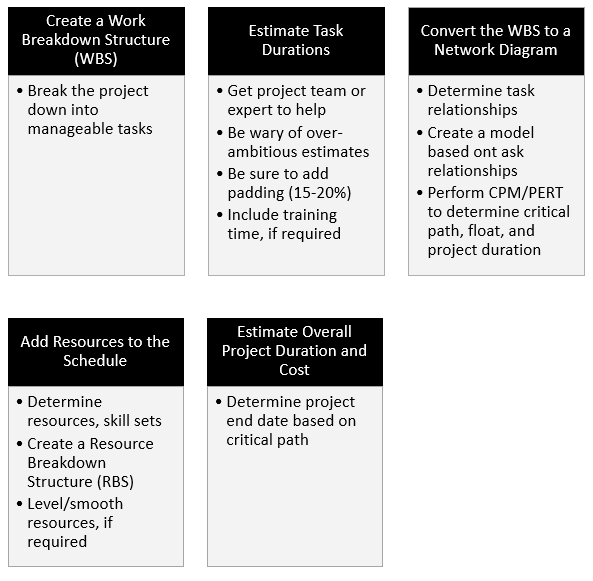
The steps involved in creating a viable schedule are: