
SESSION FIVE: THE PROBLEM-SOLVING TOOLKIT
Using an established process will help at every stage of solving a problem.
In this session, you will look at seven basic problem-solving tools and two advanced tools (the degrees of support and fishbone analysis). Creative thinking methods, including brainstorming and brainwriting, will also be discussed.
The Basic Tools
There are techniques we can use to help us at every stage of the problem-solving process.
The Lasso
Can we tighten up our definition of the problem?
- “How can we improve communication in our group?” What do we mean by communication?
- “How can we get our work done more efficiently?” What do we mean by efficiently?
Is/Is Not
The Is/Is Not technique lets us eliminate assumptions and emphasize facts. For example, someone says, “The telephone system is not working.” You might ask them to list what is not working and list what is working. Perhaps all functions are affected, or perhaps only incoming calls have been affected.
Graphics
A diagram allows us to see things visually. For example, think of personality types, which can be depicted visually as well as verbally. For some, a graph is more beneficial than a score or a label. For others, one type of categorizing is better than another type of categorizing.
Basic Questions
Who, what, where, when, why, how?
Criteria
In many situations it can be very helpful to pre-determine what the criteria will be for your best solution. For example, let’s say that you and your spouse are going out to celebrate your anniversary. Where are you going to go? Well, rather than: “Where do you want to go?” and, “I do not care. It is up to you,” how about developing criteria ahead of time?
Some examples:
- The place must have a liquor license, since you want a glass of wine with your meal.
- It should not cost too much, yet you do not want the fast food joint just down the road. A cost of $20 to $30 per person is another criterion.
- You want a place where you can have chicken and your spouse can have seafood.
- It should not be more than 50 miles away, since you both have to work tomorrow.
- It should take reservations. You do not want to go to all that trouble and then find the place has no table for you.
Now you can brainstorm, but the brainstorming will be modified or restrained, since you have already identified the criteria that the restaurant must meet.
Force Field Analysis
Force field analysis examines restraining forces (forces that discourage the problem) versus sustaining forces (forces that encourage a problem). Take an example like John arriving late for work.
What are the restraining forces?
- Boss is angry
- John is behind with his work
- Parking spots all gone
What are the sustaining forces?
- Gets to sleep an extra 15 minutes
- Takes the kids to the babysitter
- Misses traffic on way to work
Then the question becomes, how can we weaken the sustaining forces and strengthen or shore up some of the restraining forces?
Legitimizing Problems and Positions
Problems are okay. Everyone has problems. They are a fact of life. Human beings could not live without change in their environment, without stimulation, and problems provide that change and stimulation. So it is all right to have a problem as long as you are willing to do something about it.
In our society we often think that having a problem is like admitting failure. Some of us refuse to admit we have problems, or we ignore or hide them.
Everyone sees things differently, especially problems. Did you ever stop children from fighting and ask what the problem was? You would usually get a discordant chorus of responses as to why they were fighting, and each would see the fight from their own perspective. This expression of our personal view, no matter how discordant it may be, needs to be legitimized. To do this, we can use the communication funnel.
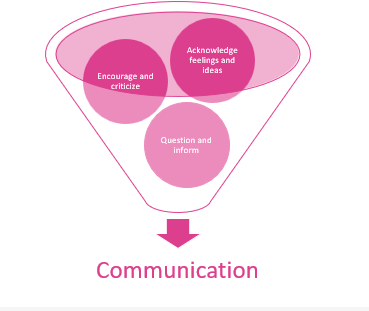
If you are working with two employees who are in conflict, for example, each one must have their perception of the problem legitimized. You are not telling one they are right and the other they are wrong. Rather, you are demonstrating that you accept and support each view as legitimate, and will protect it from attack until it has been explored. Showing people that their view has been heard and accepted will reduce the tension and let them relax, at least a bit. Only then can you go on to find common ground, identify what is at the root of the problem, make decisions on solutions, and move ahead.
The Fishbone
The fishbone problem-solving tool visually organizes information:
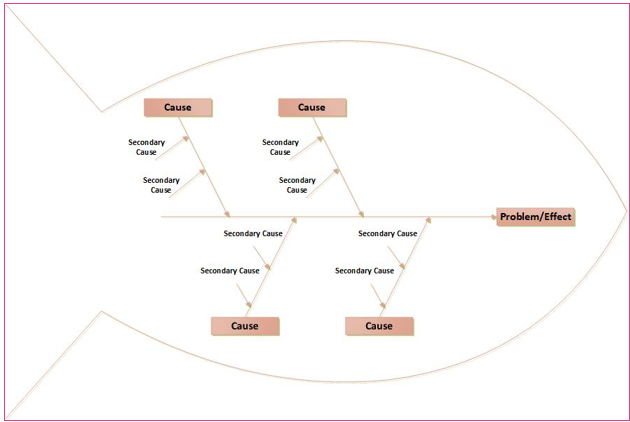
This tool is also called the Ishikawa diagram, after the Japanese quality management consultant who created it. It is an excellent method for solving complex problems, and for identifying the root cause(s) associated with it. It is most effective when used by a group. The facilitator starts the discussion by drawing the outline of the diagram, and then asks for assistance from the group to identify the main causes. Each cause is listed separately (one per fishbone). The team continues making suggestions to fill out the entire diagram. Once the problem is laid out in this visual way, the team can decide what the root causes of the problem are. The causes are highlighted, and then can be acted upon.
One advantage of the fishbone diagram is that we can clearly see the reasons that a situation or problem exists, because we list all the factors that influence it. It is also possible to identify solutions that might help solve more than one problem, especially if you are applying it in a larger workplace where manufacturing, building, or other processes are taking place.
This diagram can be used as a one-time exercise, or it can become a working document that is updated as various solutions are tried or more information becomes available.
Degrees of Support
There are shades of gray everywhere in life, and decision-making is no different. If participants can apply the degrees of support instead of having to select yes or no, they may feel some relief that they are not taking sides. The degrees of support may help them articulate exactly how they feel about a decision.
No Need for Black-and-White Thinking
Using Degrees of Support will help a group realize that consensus does not mean that everyone agrees to the same degree. The circular nature of the diagram (which reflects the symbol for degree, or o) demonstrates how we may increase or decrease the strength of our commitment to a decision in response to getting more information, considering a different perspective, and moving through the problem-solving process.
Degrees of Support
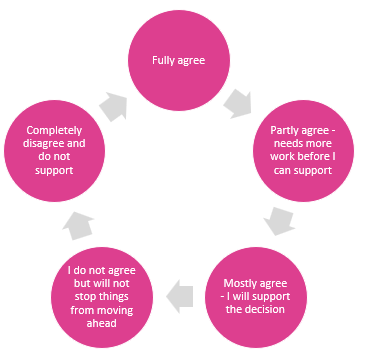
Little in life is really so clear that it needs to be discussed in terms of an absolute yes or no. Like the diagram, we really consider things in terms of degrees, especially when moving through the problem-solving process.
Creative Thinking Methods
Brainstorming
About Brainstorming
Earlier, we talked very briefly about brainstorming to get you started thinking about it. Brainstorming is the first thing that comes to most people’s minds when we talk about creative thinking. In a brainstorming session, people are encouraged to say what comes to their mind, and all the ideas generated are recorded. People are encouraged to say whatever they are thinking, and are not to fear looking foolish since wild ideas are explicitly encouraged. There is no one right way to run a brainstorming session. Rather, you should tailor it to your needs and resources. In doing so, you may find it useful to consider the following guidelines.
Before Brainstorming
- Define your purpose. Think of what you would like to walk out of the meeting with.
- Choose the participants. The group should be large enough to provide a stimulating exchange, yet small enough to encourage both individual participation and invention. This usually means between five and eight people.
- Change the environment. Select a time and place that distinguishes the session as much as possible from regular discussions. The more different a brainstorming session seems from a normal meeting, the easier it is for participants to suspend judgment.
- Design an informal atmosphere. What does it take for you and others to relax? It may be talking over a drink, meeting at a vacation lodge, or simply taking off your tie and jacket during the meeting.
- Choose a facilitator. Someone at the meeting needs to facilitate to keep the meeting on track, make sure everyone gets a chance to speak, enforce any ground rules, and stimulate discussion by asking questions.
During Brainstorming
- Seat the participants side-by-side in chairs facing a flip chart. Physically sitting side-by-side can reinforce the mental attitude of tackling a common problem together.
- If the participants do not all know each other, the meeting begins with introductions all around.
- Then, clarify the ground rules, including a no-criticism rule.
- Outlaw negative criticism of any kind.
- Once the purpose of the meeting is clear, let your imaginations go. Try to come up with a long list of ideas, approaching the question from every conceivable angle.
- Record the ideas in full view. Recording ideas on large sheets of paper gives the group a tangible sense of collective achievement, reinforces the no-criticism rule, reduces the tendency to repeat, and helps stimulate other ideas.
After Brainstorming
- After brainstorming, relax the no-criticism rule in order to bring the most promising ideas to the surface. You are still not at the stage of deciding; you are merely nominating ideas worth developing further. Circle the ideas that members of the group think are best.
- Take one promising idea and invent ways to make it better and more realistic, as well as ways to carry it out. The task at this stage is to make the idea as attractive as you can. Preface constructive criticism with: “What I like best about that idea is…” or, “Might it be better if…?”
- Before you break up, draw up a selective and improved list of ideas from the session and set up a time for deciding which of these ideas to take further and how.
Limitations of Brainstorming
There are some noted challenges with brainstorming, although it remains a favorite method of creative idea generation. Despite a facilitator’s best efforts to get everyone involved, there are always some people who limit or filter what they say in a brainstorming session, and the sessions can sometimes benefit from the extroverts more than the introverts. Verbal traffic jams, where we are waiting for our turn to share, lead to filtering our own ideas before stating them or even forgetting what we wanted to say.
Another limitation to brainstorming relates to its very social nature. If we are involved in a brainstorming session and it is set to take place off site, or involves a particular group of people, production can be lower than expected in a brainstorming session. Fortunately, there is a great tool to overcome these problems: brainwriting.
Brainwriting
Brainwriting takes all the best elements of brainstorming (plentiful ideas creatively generated) and makes them even more effective. Brainwriting was originally made popular in Germany during the 1970s, although it may have originated prior to that. Further developed by creativity expert Arthur B. VanGundy, Ph.D. (1946-2009), brainwriting uses individual work to creatively increase the number of ideas generated.
There are several methods to brainwriting. The interactive method has everyone gather around a table. Each will write down one idea on a piece of paper and then pass the paper to the person beside them. That person will read what is on the page and use the initial idea as stimulus for a new idea, modify or enhance the original idea, and then pass the page to the next person. A limit of 15 to20 minutes can be set for the exercise, which will end when each person gets back their original page.
There are plenty of variations you can apply to this exercise to encourage creative thinking. You could use differently colored paper or hang flip chart pages on the wall and have participants move around the room instead of passing paper around. You could also fold paper into paper airplanes, throw them to each other, and write all over the wings. Get as creative as you like! Another idea: have the writing surface somehow reflect the problem, the environment, or just get people moving.
In-depth research conducted by Dr. VanGundy demonstrated that brainwriting consistently produced more ideas than traditional brainstorming, given the same sized group and amount of time. He attributes the difference to ‘production blocking,’ where only one idea can be generated and written down at a time during brainstorming, as opposed to each member of the group writing simultaneously. (See Dr. VanGundy’s books Techniques of Structured Problem Solving and Managing Group Creativity.)
Mind-Mapping
Once the ideas have been generated, mind-mapping can be used to organize them.
Step One: Create a List
Topic
- Adopting a puppy
Related Ideas
- Adoption = community oriented
- Require warranty for good health
- Must be neutered/spayed
- Can be male or female
- What breed?
- Family dog?
- What size?
- Dry food, canned, or raw?
- Company during lonely evenings
- Training required!
- Requires brushing regularly
- Will get me out walking every day
- Needs a sweater
- I need to learn to trim nails
- Need a vet
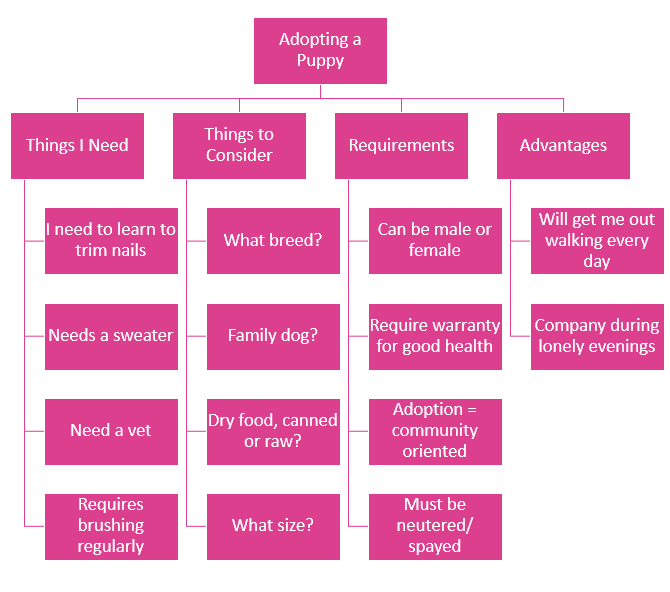
Step Two: Create the Diagram
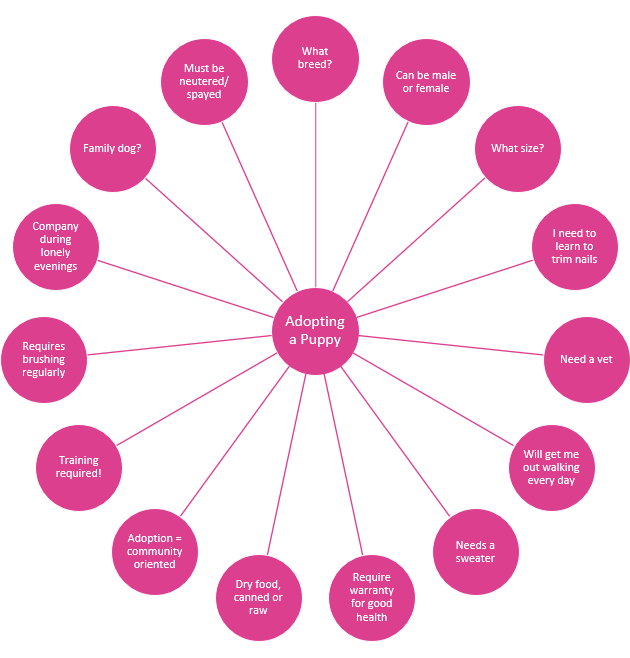
List each idea in its own box, with the main topic at the center.
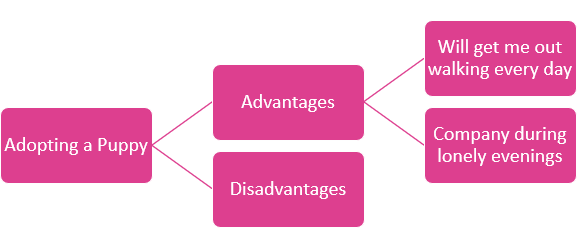
Step Three: Link and Categorize
Now, you can begin linking and categorizing the ideas:
Step Four: Finalize and Review
Look at the final product. Evaluate and review as needed.
More Methods
Random Word Method
Another interesting technique is the random word method. First, open a dictionary. Then, close your eyes, choose a page, and point to a word. You must use the first word you choose. Then, write the word on a flip chart and try to figure out how that word applies to your problem. Perhaps you are working on a decline in sales and your word is “tiger.” You could say that we need a tougher approach, or a brighter idea.
Do not Re-Invent the Wheel
When you have solved a problem successfully, or if you hear about a creative solution, write the solution down in a log. Then, when you are having trouble problem-solving, refer back to the log to get your creative juices started. You may even be able to take certain elements of different solutions and bring them together to create a solution for your particular problem.
Do Something Different
Creativity takes work. Do not be surprised if sometimes you are supposed to be problem- solving, and your ideas do not flow, so you do something different. Take a walk, bounce a basketball, browse a bookstore, or do something that is at a different pace, in a different place, or requires a different part of your brain. You will find yourself refreshed and recharged when you get back to the problem at hand.