
SESSION FIVE: SETTING PRIORITIES
Once you have mastered setting goals and you know strategies for planning, the next step is to learn how to set priorities.
In this session, you will review the Urgent-Important Matrix, and learn how to manage interruptions and distractions.
Prioritizing Your Tasks
The Urgent-Important Matrix
Former United States President Dwight Eisenhower once said, “What is important is seldom urgent and what is urgent is seldom important.” He based his time management around this idea. Other personal productivity experts, including Stephen Covey and Laura Stack, have brought this idea into the mainstream in recent years.
Eisenhower’s matrix is pictured on the next page. It can help us determine what is urgent, what is important, and most importantly, how we should be spending our time.
- Important is defined as an activity that will help you complete your goals.
- Urgent is defined as something that has a deadline attached to it.
Matrix Overview
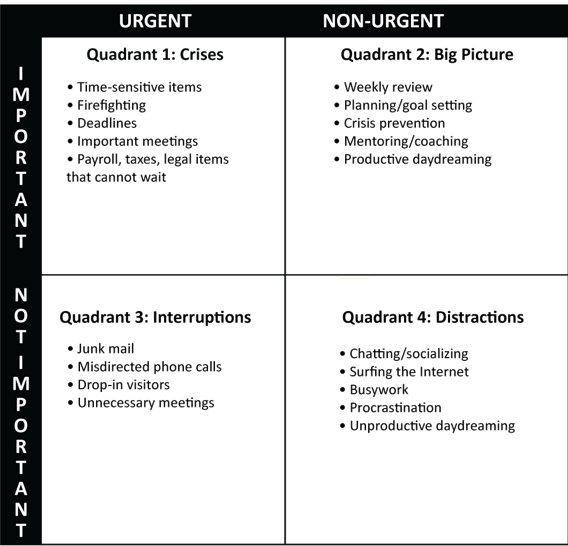
Quadrant 1: Urgent and Important
These are the things that need to get done NOW. This is the payroll deadline, dealing with an upset client, and completing your income tax return. Ignoring these items will result in major disasters.
This is where many people find that their time gets eaten up. “I cannot control when clients get upset!” you might say. “Dealing with an interruption like that always throws my day off kilter.”
You are certainly right about one thing: these situations often cannot be controlled. However, their frequency and impact can often be reduced by employing activities in Quadrant 2.
Quadrant 2: Important but Not Urgent
These are the big-picture items: the things that may not have a deadline but are crucial to your long-term success. This is where weekly review, goal setting, and information management fits in. Time spent here is invested in yourself, in others, and in the future. Activities here should diminish the number of Quadrant 1 items, reducing stress, minimizing crises, and making you feel more in control.
Quadrant 3: Urgent but Not Important
These are the time-wasters that can suck the life out of anyone’s day. Unnecessary meetings, drop-in visitors, improperly delegated projects, and pointless reports all fall into this category.
There are a few ways to manage interruptions. We do not recommend an open-door policy – it is just too disruptive. But locking yourself in your office like a hermit can result in small problems spiraling out of control. Instead of one of these all-or-nothing approaches, think about using one of these techniques in your office.
Set Office Hours
Set aside specific hours in the day when your door will be open, like professors do. Make exceptions for emergencies.
Institute a Quiet Time Policy
Some organizations have successfully instituted a timeframe where employees cannot interrupt each other or schedule meetings. The best time is typically first thing in the morning or during a period of time when customers are not coming in.
Set up a Signal System
Meet with your department and agree on a signal that will indicate not to interrupt them unless it is an emergency. Some popular ideas:
- Wearing an armband or hat
- Installing curtains across cubicle doors
- Turning your nameplate around
- Hanging a sign on the door
This system will only work if employees use it properly and do not abuse it.
Create an Information Center
If people are constantly visiting your office looking for forms, brochures, or other standard information, try hanging a file system outside your office door, clearly labeling each section, and filling it with those items. Be sure to include your contact information in case they have questions.
Managing interruptions will be explored further in this session.
Quadrant 4: Not Urgent and Not Important
These are the activities that produce the most waste. Lingering over coffee, surfing the internet for hours, mindless TV watching, and gossiping around the lunch table are all activities that eat up our time but do not have any tangible results. Watch out for these black holes in your day! True recreation should re-energize you, not turn you into a mindless zombie.
Managing Interruptions and Distractions
In a study completed by the University of California, Irvine, researchers found that a typical office worker is interrupted or switches tasks an average of every three minutes and five seconds. The study also found that after being interrupted, it can take as much as 23 minutes and 15 seconds to get back on track.
Interruptions also occur more often in shared workspaces or cubicles – 29 per cent more than people who have private offices. Studies have also found that error rates can double or triple after an interruption of only a few seconds.
These statistics clearly show that reducing interruptions and distractions is key to good time management. It is crucial to accept that interruptions will happen, and that you must do what you can to plan for them.
Tips for Controlling Disruptions
- For a few days, keep a log of any interruptions that occur. Then use this information to determine whether the interruptions were valid or not valid and make a plan for dealing with these types of interruptions in the future.
- Research shows that people interrupt themselves 44 per cent of the time. It is important to maintain focus and be fully engaged in the work you are doing. Turn off notifications and close browser windows such as social media when you are not using them, to safeguard against being distracted by alerts.
- Schedule times for completing certain tasks such as checking email or returning phone calls.
- If absolute concentration is needed, work in a location away from your desk where you are less likely to be interrupted.
- Discourage interruptions by closing your door or wearing headphones, which also block out conversations other people are having around you that may distract.
- Evaluate and change your physical workspace to discourage distractions. For example, face away from the door so that your attention is not drawn away every time someone walks by.
- If you are in the middle of a task, learn to say no when people interrupt, or politely ask them whether you can speak with them at another time. Make sure you follow through.
- Determine times when you are available or not available, especially if you are a supervisor, and clearly communicate to your co-workers that they should not disturb you during these times unless it is an emergency, or the matter is something both urgent and important that cannot wait until a later time.
- When you are interrupted, save electronic files and mark your place so that you can easily return to that spot. This ensures that time is not wasted trying to remember what you were doing before the interruption occurred.