
SESSION SIXTEEN: CREATIVE TEAM THINKING
Sometimes when you have to make a decision it can be hard just to generate a few options, let alone set up a plan. If you apply a process, however, you can make the solutions and action planning much easier.
In this session, you’ll learn about some very tangible creative thinking tools, including brainstorming, brainwriting, and the thinking hats.
Creative Thinking Methods
Brainstorming
About Brainstorming
Brainstorming is the first thing that comes to most people’s minds when we talk about creative thinking. In a brainstorming session, people are encouraged to say what comes to their mind, and all the ideas generated are recorded. People are encouraged to say whatever they are thinking, and are not to fear looking foolish since wild ideas are explicitly encouraged. There is no one right way to run a brainstorming session. Rather, you should tailor it to your needs and resources. In doing so, you may find it useful to consider the following guidelines.
Before Brainstorming
- Define your purpose. Think of what you would like to walk out of the meeting with.
- Choose the participants. The group should be large enough to provide a stimulating exchange, yet small enough to encourage both individual participation and invention. This usually means between five and eight people.
- Change the environment. Select a time and place that distinguishes the session as much as possible from regular discussions. The more different a brainstorming session seems from a normal meeting, the easier it is for participants to suspend judgment.
- Design an informal atmosphere. What does it take for you and others to relax? It may be talking over a drink, meeting at a vacation lodge, or simply taking off your tie and jacket during the meeting.
- Choose a facilitator. Someone at the meeting needs to facilitate to keep the meeting on track, make sure everyone gets a chance to speak, enforce any ground rules, and stimulate discussion by asking questions.
During Brainstorming
- Seat the participants facing the problem side-by-side. Physically sitting side-by-side can reinforce the mental attitude of tackling a common problem together. People sitting side-by-side in a semicircle of chairs facing a flip chart, for example, tend to respond to the problem depicted on the chart.
- If the participants do not know each other, the meeting should begin with introductions.
- Then, clarify the ground rules, including a no-criticism rule.
- Outlaw negative criticism of any kind.
- Once the purpose of the meeting is clear, let your imaginations go. Try to come up with a long list of ideas, approaching the question from every conceivable angle.
- Record the ideas in full view. Recording ideas on large sheets of paper gives the group a tangible sense of collective achievement, reinforces the no-criticism rule, reduces the tendency to repeat, and helps stimulate other ideas.
After Brainstorming
- After brainstorming, relax the no-criticism rule in order to bring the most promising ideas to the surface. You are still not at the stage of deciding; you are merely nominating ideas worth developing further. Circle the ideas that members of the group think are best.
- Take one promising idea and invent ways to make it better and more realistic, as well as ways to carry it out. The task at this stage is to make the idea as attractive as you can. Preface constructive criticism with: “What I like best about that idea is…” or, “Might it be better if…?”
- Before you break up, draw up a selective and improved list of ideas from the session and set up a time for deciding which of these ideas to take further and how.
Limitations of Brainstorming
There are some noted challenges with brainstorming, although it remains a favorite method of creative idea generation. Despite a facilitator’s best efforts to get everyone involved, there are always some people who limit or filter what they say in a brainstorming session, and the sessions can sometimes benefit from the extroverts more than the introverts. Verbal traffic jams, where we are waiting for our turn to share, lead to filtering our own ideas before stating them or even forgetting what we wanted to say.
Another limitation to brainstorming relates to its very social nature. If we are involved in a brainstorming session and it is set to take place off site, or involves a particular group of people, production can be lower than expected in a brainstorming session. Fortunately, there is a great tool to overcome these problems: brainwriting.
Brainwriting
Brainwriting takes all the best elements of brainstorming (plentiful ideas creatively generated) and makes them even more effective. Brainwriting was originally made popular in Germany during the 1970’s, although it may have originated prior to that. Further developed by creativity expert Arthur B. VanGundy, Ph.D. (1946-2009), brainwriting uses individual work to creatively increase the number of ideas generated.
There are several methods to brainwriting. The interactive method has everyone gather around a table. Each will write down one idea on a piece of paper and then pass the paper to the person beside them. That person will read what is on the page and use the initial idea as stimulus for a new idea, modify or enhance the original idea, and then pass the page to the next person. You can set a limit of 15-20 minutes for the exercise, which will end when each person gets their original page back.
There are plenty of variations you can apply to this exercise to encourage creative thinking. You could use differently colored paper or hang flip chart pages on the wall and have participants move around the room instead of passing paper around. You could also fold paper into paper airplanes, throw them to each other, and write all over the wings. Get as creative as you like! Another idea: have the writing surface somehow reflect the problem, the environment, or just get people moving.
In-depth research conducted by Dr. VanGundy demonstrated that brainwriting consistently produced more ideas than traditional brainstorming, given the same sized group and amount of time. He attributes the difference to “production blocking,” where only one idea can be generated and written down at a time during brainstorming, as opposed to each member of the group writing simultaneously. (See Dr. VanGundy’s books Techniques of Structured Problem Solving and Managing Group Creativity.)
Mind Mapping
Once the ideas have been generated, mind mapping can be used to organize them. With mind mapping, we start to draw links between the ideas and put them together.
Step One: Create a List
Topic
- Adopting a puppy
Related Ideas
- Adoption = community oriented
- Require warranty for good health
- Must be neutered/spayed
- Can be male or female
- What breed?
- Family dog?
- What size?
- Dry food, canned, or raw?
- Company during lonely evenings
- Training required!
- Requires brushing regularly
- Will get me out walking every day
- Needs a sweater
- I need to learn to trim nails
- Need a vet
Step Two: Create the Diagram
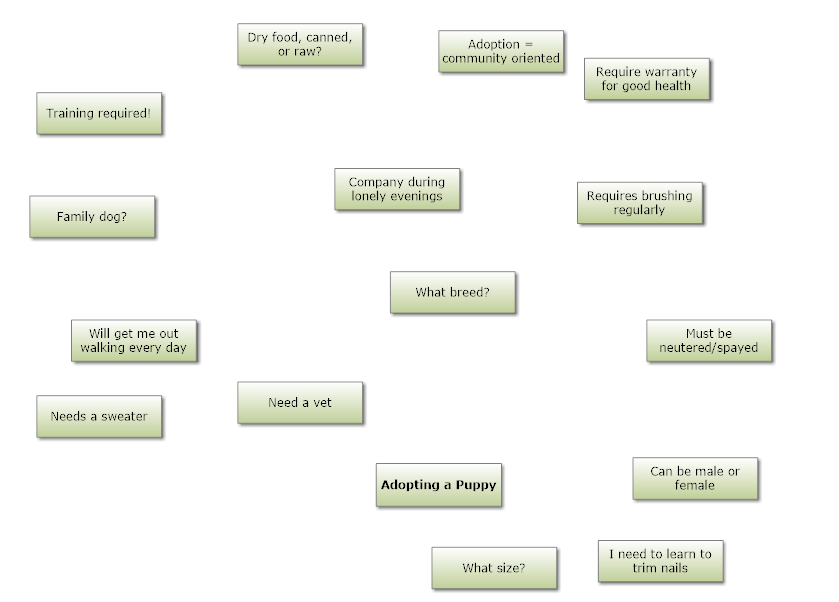
List each idea in its own box, with the main topic at the center.
Step Three: Link and Categorize
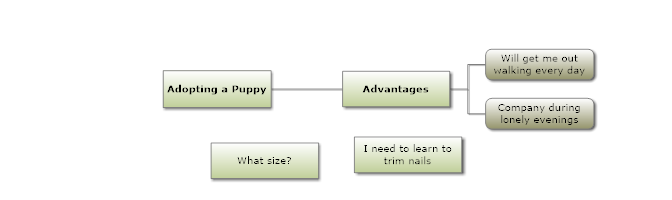
Now, you can begin linking and categorizing the ideas
Step Four: Finalize and Review
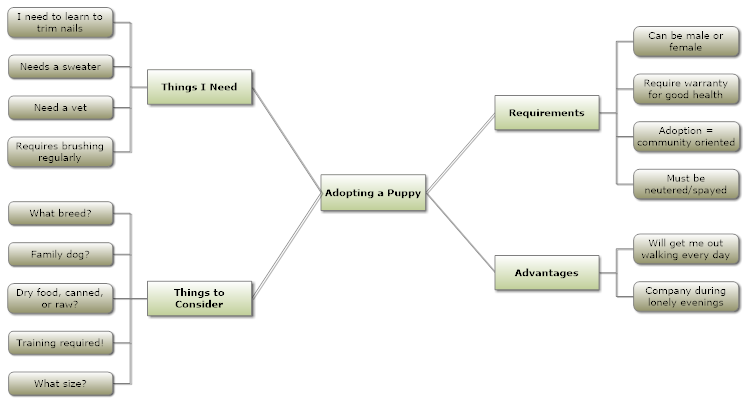
Look at the final product. Evaluate and review as needed.
Brainstorming and Brainwriting
Think of a problem facing you at work or a topic that you could use some fresh ideas on. Write it in the center circle of the diagram below. Then, write ideas about the topic in the outer circles. Be creative!

Six Thinking Hats
Edward DeBono is credited with designing a program for thinking that is well applied to a team process of making decisions, generating ideas, and avoiding things that bog a team down. Called Six Thinking Hats, the idea is to organize the team into separate strands of thinking to keep people focused and to thoroughly analyze a problem.
The six thinking hats method is designed to switch thinking away from a common debate or argument style to a map-making style. This process forces thinking into a two-stage process. The first stage is to create the map, and the second stage is to select the route to follow. If the map is good, the best route will often become obvious.
Each person is assigned to a particular hat, and responsible for putting that type of thinking on the map.
- White Hat: Facts, figures, and information that is already known or needed.
- Red Hat: Emotions and feelings, including hunches and intuition.
- Black Hat: Devil’s advocate, negative judgment, difficulties, asks why it will not work.
- Yellow Hat: Brightness and optimism, positive, constructive, and why something may work.
- Green Hat: Creative, possibility, solutions, movement, provocation.
- Blue Hat: Process management, benchmarks, staying focused, action plans, and implementation.
At first, people often feel a little awkward about using the different hats, especially if they are assigned a form that they are not completely comfortable with. Awkwardness passes as the benefits to the system becomes apparent. In order to get the team used to the process, apply it in the form of an occasional request to use one hat or to switch from the black hat to a different color.
Value of the Six Thinking Hats
The great value of the hats is that they provide thinking roles. A thinker can look at things from a different point of view by acting each of these roles. Without the formality of the hats, some thinkers would remain permanently stuck in their most comfortable or usual mode, instead of unleashing some creativity.
White Hat Thinking
In this mode, the thinker imitates a computer. They remain neutral and objective, avoiding having to offer opinion, while providing facts or data that are required.
You can be asked to put on the white thinking hat or you can ask someone to put it on. You can also choose to put it on, or to take it off.
The white (absence of color) also indicates neutrality.
Red Hat Thinking
Wearing the red hat allows the thinker to say: “This is how I feel about the matter.”
The red hat incorporates emotions and feelings as an important part of thinking. The red hat allows for feelings and emotions to become visible, and to become a part of the thinking map.
The red hat allows a thinker to explore the feelings of others by asking for a red hat view. When a thinker is using the red hat there is no need to justify the feelings or to provide a logical basis for them.
The red hat thinker can draw on strong emotions like fear and dislike, and also incorporate some more complicated ones like suspicion, intuition, relying on senses like taste or aesthetics.
If you find that an opinion has a considerable amount of feeling associated with it, they can also fit under the red hat.
Black Hat Thinking
Black hat thinking is specifically concerned with negative assessment. The black hat thinker points out what is wrong, incorrect, and in error. The black hat thinker points out how something does not fit experience or accepted knowledge, and why something will not work. Risks, dangers, fault with design or process also are included here.
Black hat thinking is a valued part of the discussion, and should not be seen as argument. The black hat thinker presents what is wrong, including errors in fact, or how something doesn’t fit a belief. Risks as well as design and process faults can also be part of black hat thinking.
Black hat thinking can ask negative questions but it should not be used to cover negative indulgence or negative feelings. Those would be red hat functions.
Yellow Hat Thinking
Yellow hat thinking is positive and constructive. Think of bright sunshine and optimism with yellow hat thinking. Where black hat thinking is concerned with negative assessment, yellow hat thinking is concerned with positive assessment. Yellow hat thinking covers a positive spectrum ranging from the logical and practical at one end to dreams, visions, and hopes at the other end. This range allows probing and exploration for values and benefit.
Yellow hat thinking is constructive and generates action that includes concrete proposals and suggestions, action plans and implementation. Yellow hat thinking can be speculative and opportunity seeking but it can also permit visions and dreams to take place and receive consideration.
Green Hat Thinking
The person who puts on the green hat is going to use the mechanisms of creative thinking, look at possibilities and also provocation. Everyone involved is required to treat the output as a creative output. Ideally both the thinker and listener should be wearing green hats.
The green color symbolizes fertility, growth, and the nurturing of ideas among a search for alternatives.
Provocation is an important part of green hat thinking. A provocation is used to shift us out of our usual patterns of thinking.
Blue Hat Thinking
The blue hat is the control hat. The blue hat thinker organizes the thinking itself, and includes thinking about the thinking needed to explore the subject. The blue hat thinker is like the conductor of the orchestra, calling on the other hat to play their parts.
The blue hat thinker defines the subjects toward which the thinking is to be directed, defines the problems, shapes the questions, and provides the structure and focus for thinking to be taking place. Blue hat thinking determines the thinking tasks that are to be carried through and is responsible for summaries, overviews, and conclusions. These can take place from time to time in the course of the thinking, and also at the end.
Even when the specific blue hat thinking role is assigned to one person, it is still open to anyone to offer blue hat comments and suggestions.