
SESSION FIVE: THE CONVERSATIONAL LEADERSHIP FRAMEWORK
Conversational leadership allows us to tap into wisdom and knowledge that is held by employees, stakeholders, and other interested parties. This is information that we would not have access to otherwise.
In this session, you’ll learn the elements of conversational leadership practice, including how to apply a framework for conversation and get things started.
Getting Started
| “Conversations are the way workers discover what they know, share it with their colleagues, and in the process create new knowledge for the organization. In the new economy, conversations are the most important form of work…so much so that the conversation is the organization.” (Alan Webber, “What’s So New About the New Economy,” Harvard Business Review) |
The term conversational leadership was created by Carolyn Baldwin, an educator, Appreciative Inquiry practitioner, and World Café host. When she accepted a position as a school head, she invited staff to a circle-style meeting, using appreciative inquiry and World Café techniques.
Circles have been used as safe, sacred conversation forums for years. Whether the gathering is of village elders or a corporate meeting, the idea of a circle is that it is a place for sharing and gathering wisdom. The ritual that kicks off the circle, and the creation of an atmosphere based in the methodologies used, are part of a strategy to evoke deep conversation.
One idea of having people seated in a circle is that everyone present is an equal – there is no head of the table or power seat as depicted in corporate meeting rooms. The organizer typically calls the circle together and has developed a question (in advance) that will help start conversations that draw out the wisdom of those present.
Since conversational leadership has commonalities with appreciative inquiry, it’s important to note that both approaches focus on positive circumstances. A helpful starting place for participants is to look at what’s going well and where improvements and innovation can occur, as opposed to looking for things to criticize or demean.
Circles are most appropriate when:
- People are ready to engage in deep, meaningful conversation with each other.
- Powerful questions are ready to be considered by groups with common interests and language.
- Participants are prepared for deep, profound change that can result from meeting this way.
Circles are not so great when:
- The organizational culture is not open to deep conversation.
- People are ready to speak intellectually about issues but not ready to open up emotionally or spiritually.
- Participants are not ready to participate in a kickoff ritual. For example, a reflection exercise, meditation, or prayer are common ways to start.
What You’re Aiming For
The aim of these deeply powerful conversations is to generate meaning. One result that participants find is that although they might expect just another boring meeting, they come away feeling as though people have actually listened to what they had to say, and that in many cases, they connected with people in what was the first time they had ever really spoken with one another. Often we seem to have meetings just for the sake of meetings, so you need to know going in that this is something very different.
For example, if a board of directors is to meet and talk about fundraising, they will probably generate lots of ideas for how to raise funds. That seems logical. However, when you use conversational leadership, that board gets a chance to speak at a deeper level.
For example, when the board for the Museum of Science and Industry in Tampa Bay, Florida got together, they hosted a conversational leadership style World Café. Instead of simply raising money for the museum, they discovered that there were a lot of blue collar and low income families who couldn’t afford to visit the museum, so they set up an endowment fund to provide the public with full access to the museum.
In another stunning result of conversational leadership and tapping into the wisdom of participants, that same museum was facing layoffs one year. The hosted a World Café hoping to figure out how to raise $175,000. They ended up creating a plan that included $188,000 of new ideas that actually resulted in raising $267,000 – all by tapping into the ideas of people at the café.
Participants at the meetings were not managers and directors. They were people with great ideas about how to produce big revenues in a way that reflected the museum’s mission and values. People who never saw one another because they worked opposite shifts or in different operational areas were able to connect and share. Over time and with increased experience in the café philosophy, they find the process keeps getting better and the results keep improving. The museum has even invited participants from outside the organization, including potential and actual museum visitors, to collaborate on exhibits. This approach builds engagement in the museum, engages people at a community level, and is helping to build the museum’s revenue.
Creating the Conversation
We’ve already mentioned that conversational leadership has a strategic component to it. In order to realize the desired results, and to get efficient with what you are doing, you can review the framework that has been created by Thomas Hurley and Juanita Brown:
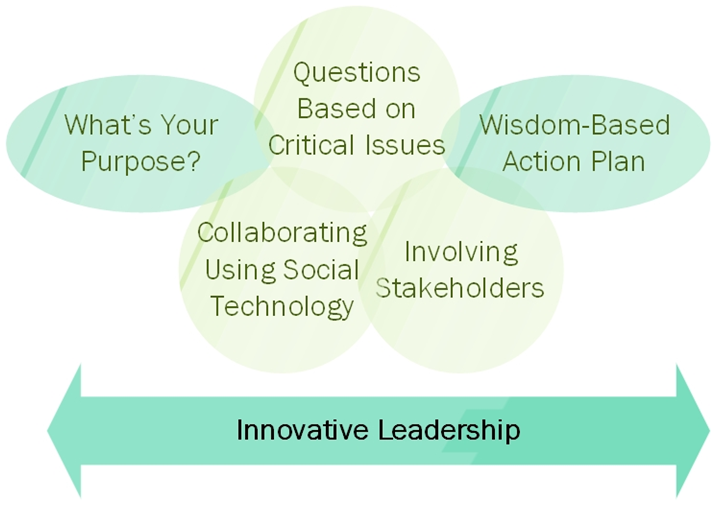
This framework is straightforward and can be applied to a variety of meeting types, from single meetings that take place during a single World Café to long-term strategic initiatives. World Café leaders must teach the framework to their own participants so that they understand how their input influences positive outcomes. This encourages them to be at their most open and engaged during your sessions.
As you consider the processes identified in the model, take a minute to consciously think about how you will use them. Consider how they can strengthen your experience as a conscious leader, and in using conversational leadership. As well, think about the impact that it could have if you don’t use one of the elements effectively, or you leave it out.
Identifying Your Purpose
Key Questions
Before deciding on a conversation café purpose, determine why this method is best for your group. We recommend that you attend a few cafés if possible so that you can see and feel for yourself how powerful this approach can be.
Then, determine the purpose for your café. You also need to recognize the intention that is guiding you. This will help you in the design of your particular café, and has a large bearing on your success.
When we speak about purpose and strategic intent, it might sound very prescriptive. However, in reality it must remain flexible in terms of how you will get where you are going. It also needs flexibility so that you can adapt and improvise as the action unfolds.
The Physical Setup
A conversation café is actually designed to look like a café. Tables are small and round, and the place is decorated to reflect the atmosphere of a local, traditional café. Checked tablecloths, a small arrangement of flowers on each table, and availability of refreshments are all part of the mood. Don’t dismiss an element thinking that it is unnecessary, because to do so means that you aren’t hosting a conversation café.
Instead, ask yourself:
- Why are we gathering people for this conversation?
- What needs or problems will we address?
The Finishing Touches
You can even create a special name for your conversation café to reflect the purpose. Some creative ones include:
- Strategy Café
- Product Development Café
- Fundraising Café
- Operations Café
When you settle on the purpose, it’s common to see a shift from what leaders thought the café would accomplish, to something at a deeper level. For example, the initial purpose of a conference might be to provide expert information on the economy. However, a café creates a collaborative space where participants can exchange local, regional, and international experience while generating knowledge focused on answering the questions posed.
Above and Beyond
It’s not unusual for the most powerful café outcome to involve the discovery of the right questions to ask about a particular issue. They may also provide a forum for a situation to be explored for the very first time. These are intangible outcomes, just like forming new relationships, information sharing, and gathering contributions from people typically excluded from strategy or decision making in the company
Involving Your Stakeholders
The Importance of Involvement
If you want to really access a diversity of thought and collective wisdom, it’s critical to invite the right stakeholders. Even once you have your initial thoughts about who should be there, it’s worth a second look to see who else can help you achieve your purpose, what other perspectives might bring valuable insights, and who would benefit by being involved in the conversation.
In old-style command and control management, it wasn’t unusual to deliberately leave people out of the decision making, particularly if their job roles were going to be affected. People also got left out if they offered a different perspective to the status quo, or they asked too many questions.
In conversational leadership, we encourage questions and want meaningful conversations. This cannot be achieved by inviting people who don’t have different perspectives or who aren’t comfortable participating in a conversational approach. Your outcomes are better when you can draw in people who were perhaps previously isolated from conversation. This isn’t that unusual since we encourage lots of cross-functional dialogue in the workplace these days, and it shouldn’t be overlooked in your invitation list. Think of it as nurturing a space that encourages an ecology of thought to get at a deep understanding of important issues, and to develop workable solutions.
Applying the Concepts
Some of the great examples we’ve heard of include inviting a cross-section of internal staff as well as external product and service users. For example, in the case of a school-based project, teachers, principals, and board members would probably be expected. But you could also invite students and members of the public in the area where the school is located.
In the case of a café for health facilities, like a nursing home, you could include staff from all departments, residents (patients), suppliers of goods and services, and members of the community from the surrounding area. You could also include people with experience working with nursing homes in similar or vastly different communities.
International companies, even those with thousands of employees, have held World Café style events around the world so they could include as many people as possible. Nokia did this by hosting cafés in nine countries and involving more than 3,000 employees when they reviewed their core values. It was an amazing undertaking, and culminated in an international café they called a “Nokia Jam” that included all their employees worldwide for a 72 hour strategy dialogue. By being so inclusive and including people from all functions, cultures, and hierarchies, their new values were widely embraced.
Summary
The more open you are to a diversity of participants, and the more you prepare them for the experience, the more meaningful conversations and better results you can expect. If you decide that involving all your key stakeholders is too expensive or time-consuming, or there aren’t enough people ready for these conversations, then your organization isn’t quite ready for conversational leadership or the World Café approach just yet. Keep working on it.
Asking Questions Based on Critical Issues
You’re probably considering a conversational leadership approach to some important questions. Since the questions you ask become the impetus for both action and change, you want to create them carefully. Depending on the situation and groups you work with, you don’t even have to design the exact questions themselves – your participants and stakeholders could do that as part of this process.
For example, if your organization no longer lives the values stated in your guiding vision for the company, you could create a topic statement and then have some stakeholders create a few questions. Then, as part of your conversations, those questions will likely lead to other questions.
From an appreciative inquiry perspective, we know it’s important to phrase your questions engagingly and positively. Here are some additional guidelines to help you create the best questions possible:
- State all questions affirmatively.
- Start out with a leading question that can build on the affirmative topic choice.
- Provide a broad definition of the topic.
- Invite participants to speak in story and narrative.
- Avoid report talk and use rapport talk in your approach.
- Be okay with ambiguity; this gives participants space to explore and tap into their own creativity and wisdom.
- Value and appreciate the way things are.
- Help the person identify experiences worth appreciating by helping tap into their creativity and imagination.
- Sincerely project unconditional positive regard to the person and the process.
- Provide a safe place to evoke essential values, aspirations, and inspiration.
In appreciative inquiry, each question must be framed positively, and it will include two parts: a positive image followed by positive action. While a café approach is not the same as an appreciate inquiry interview, both parts are presented here to guide you:
- Part I: The question will evoke a real, personal experience, as a narrative that helps participants share the best experiences and learning from the past.
- Part II: In this part of the question, the interviewer works beyond the past to envision the best future.
Collaborating with Social Technology
When you plan a space for conversational leadership, you need to concern yourself with the physical space, the social space, and the information that’s being shared. In doing so, the whole environment becomes a collaborative learning technology.
Establishing the right atmosphere – one of shared purpose, collective intelligence, and planning action – doesn’t happen by accident. We have to be intentional about choosing methods of engagement that allow the process to evolve. If you miss this step, you’ll quickly see how stakeholders from diverse backgrounds can become polarized. This will lead to a long list of ideas with no way to choose solutions or initiate action.
The development of conversational leadership has spawned the evolution of very effective technologies for purposeful collaboration and conversation, including World Café, Appreciative Inquiry, Open Space, Scenario Planning, and others. In all there are more than 60 recorded methods for systems change, so it is likely that you will find something that works for you if nothing here resonates.
In addition to change methodology, the development of digital and virtual technology is also of great benefit. Online collaboration tools and project management software, web conferencing, virtual communities of practice, crowdsourcing, and social media can all be part of developing large, robust, coordinated action plans.
Conversational leadership leverages the full scope of technology to integrate tools in a skillful architecture of cascading action. If conversation is the core process, then the practitioner needs to be intentional about designing methods for people to think together in new ways. For example, Mike Szymanczyk (former CEO of Altria Group) was part of a team that developed a Game Plan where participants were assisted through dialogue and inquiry to help discover the big questions they needed to ask. The game then takes them into the next steps of creating initiatives that reply to those critical questions and lead to action. They incorporated World Café conversations, dialogue circles, open space sessions, scenario planning, and outdoor experiential learning exercises.
Without the skillful application of social technologies, conversation can deteriorate into discussion and argument, and the only solutions presented are owned by the people with the loudest voices or perceived as having the most power. Plan carefully, and you will realize the changes and results you are looking for.
Creating a Wisdom-Based Action Plan
The outcome of conversational leadership must be wise action-taking that meets the stated purpose, achieves the strategic intent, and gets the company moving where people want it to be. When leaders recognize that this holistic, living network of conversations is creating the future they design, they can then focus that network on the critical questions. They can design tools and infrastructure, like the Altria Game Plan process, that make sense for their organization and allow efficient translation from the conversations into action plans.
Best practices in every sector demonstrate that successful outcomes and measurable results are most likely when key stakeholders work together face-to-face and online to create effective engagement. This is true whether you wish to strategize, increase innovation, improve processes, or foster community connections.
The result of our conversations has to be that the collective intelligence and wisdom leads to effective action, and builds the future of our organizations.
Innovative Leadership
Developing Leaders
Schools, executive leadership programs, and most job experiences do not prepare people very well for the personal capacity or process skills required to respond to today’s organizational challenges. In fact, many school systems have cut programs that would encourage students to learn how to think creatively or to understand innovation.
In order to support the development of real leaders (people who epitomize the skills, knowledge, and personality to guide collaborative teams and systems), we need to encourage people to learn continuously, to adapt, and to create long-term value in what they do. We might also have to teach them how to think creatively and what it means to have a workplace that honors innovation and invention.
Leaders aren’t just made into leaders by way of education. Lots of leaders are very open to education but they don’t lead very well because they don’t establish relationships very well. If you Google the phrase, “Are leaders made or born?” you’ll get over 33 million results. There is lots of debate that goes on about this and part of the reason is that people don’t agree. The reality is, however, that even if someone is a “natural” leader (as in they were born that way), they will still need to learn many things, including how to communicate effectively.
Building Common Ground
Simon Sinek, leadership author and ethnographer, states that you might have people you can rely on but you only have a certain number of them that you trust. This isn’t a result of skill or experience; trust is based on what you believe. Trust comes from a sense of common values and common beliefs.
As Sinek explains it, this commonality is really apparent when we travel. Say you live and grew up in New York and you are a patriotic American. You don’t know anyone from Los Angeles, but when you travel to Paris and meet someone on the train who is from Los Angeles, it’s as if you are long lost friends as you high five and exclaim, “Oh hey! Great to meet you!”
In order to lead conversation, then, it makes a lot of sense that we want to foster commonalities, just as we want to teach people what it means to not only contribute to a conversation but also to encourage conversation in others.
Questions to Consider
To develop conversational leadership in your organization, consider the following questions:
- Do the leaders see the organization as a network where there is real work taking place in the conversations going on?
- How is the organization (and you in it) leveraging the power of conversation as a core process?
- How much of your and your colleagues’ working time is dedicated to creating the right questions and answers?
- How skilled are you and other organizational leaders about the use of techniques and technology for collaboration, sharing intelligence, and coordinated action?
- Are your work areas (including meeting areas) conducive to informal sharing and collaboration?
- How does your organization help leaders cultivate the skills and competencies that they need to be successful in conversational leadership?
These are important factors to consider as you look at how you can best be a part of conversational leadership, and how to make sure that the best results come out of it.