
SESSION NINE: ENCOURAGING CREATIVITY IN A TEAM
Generating creative solutions in a team can be wonderful at times, and frustrating at other times. Learning strategies to navigate and manage team creativity helps get the best results from teamwork, and to keep people on track.
In this session, you will investigate how to use and apply various group creativity techniques. You will also complete a variety of activities to reinforce the concepts presented.
Brainstorming
About Brainstorming
The creation of the concept of brainstorming is credited to Alex Osborn. Osborn was an advertising executive who first published the idea in his 1953 book Applied Imagination: Principles and Procedures of Creative Thinking. Brainstorming can be an individual activity or a group discussion centered on either creating ideas or solving a problem.
Creating Ground Rules
One requirement for brainstorming is that there needs to be a safe environment for people to share their ideas. Members of the group should all feel comfortable in contributing their thoughts. A way to create this safe environment is to have some ground rules for your group brainstorming sessions. These rules can be created by the group and might look like:
- Everyone must contribute.
- No idea gets criticized, no matter how unconventional.
- Be considerate of those around you. Allow a person to finish their thought before jumping in.
- One person speaks at a time.
Having guidelines can help to create a safe environment without hampering the creative spirit needed to produce innovative ideas. Additionally, if rules are not in place you may have outspoken group members taking over the session. If this happens, great ideas can be overlooked or a solution could be settled upon too early, resulting in a less than optimal solution.
Another key component to brainstorming is that wild ideas should be encouraged and criticism should be avoided. Group members should be able to use this safe space to suggest ideas that may be overlooked.
Finally, brainstorming sessions should be used to build and enhance ideas. For example, if one group member suggests an idea, other group members should be encouraged to build upon and enhance it.
Individual Brainstorming
While group brainstorming has the advantage of offering plenty of perspectives, individual brainstorming should also be promoted. A benefit of individual brainstorming is that you have more time to think about creating an idea or solution. Some people just need more time to process or perhaps they think better alone. Allowing individuals to percolate an idea can sometimes offer the breakthrough your organization needs!
Additionally, when we are in a group setting we sometimes have a tendency to focus on something that one person says. This focus may deter people from generating new ideas. Having distance, time, and individual brainstorming sessions helps to make sure you don’t overlook vital information.
Plan It Out!
Brainstorm some possible solutions for one of the following scenarios:
- A company needs to increase product sales
- How to save money (personal or work)
- A company needs to recruit engineers
- A topic of the group’s choice
Rolestorming
In the 1980’s, Rick Griggs developed the concept of rolestorming in the book Quality at Work: A Personal Guide to Professional Standards. Rolestorming is a variation on the brainstorming technique. While brainstorming is a group discussion held in the effort to solve a problem or generate lots of ideas, rolestorming is a group discussion which involves each member of the group taking on the role or character of another person in the effort to solve a problem.
The essence is that by taking on the identity of another person, rolestorming offers participants the opportunity to see things from a different perspective. The hope is that the group members will then generate ideas they may have otherwise overlooked. Additionally, since each group member is now playing a part, they may feel less inhibited and more comfortable offering ideas that may have been considered unconventional or “off the wall” in a regular group brainstorming session.
After each person has chosen who they want to be, they should get into character by asking themselves some important questions:
- How does my character view the world?
- How would my character solve this problem?
- What would my character’s stance be toward the problem or situation? What would be their attitude?
When taking on the role of others, be sure not to take on the identity of someone in the room or someone the group is familiar with. Taking on the role of a familiar person could be potentially hurtful if they are being portrayed in a disrespectful or degrading manner.
People may struggle with this technique, especially if you have any introverts in your group. People may also struggle with fully getting into character if their boss or team leader is in the room. Allow group members to ease into the task and do what they feel comfortable with. Do not be critical of ideas generated while in character.
To relieve anxiety, you may want to ease people into this technique by warming up with another technique, such as the shoe swap.
Case Study
Let’s look at an example of how this tool might be used to generate solutions.
You have a new business where you make and sell jewelry. One of your newer employees keeps missing shifts and does not call in ahead of time to let you know or arrange for a replacement worker. You have tried speaking with the employee to no avail. To solve this problem, you are going to rolestorm to help think of creative solutions.
For this particular problem, you will assume Donald Trump, the business icon, as a character.
The first question is, “How does Mr. Trump view the world?” You know that he believes that time is money and that he is notoriously hard on people with poor performance.
The second question to ask is, “How would Mr. Trump solve this problem?” Based on what you know of him, you think he would solve the problem by firing the employee for poor performance or reprimanding the employee in some way, like garnishing the employee’s wages.
The third question is “What would Mr. Trump’s stance be toward the problem or situation? What would be his attitude?” You think Mr. Trump would first garnish wages, and if the employee’s behavior did not change, he would fire them for poor performance. Mr. Trump’s attitude would be that this is your business and you have to protect its integrity. You can always get another employee, but starting a new business is another story.
You now have a plan for action to solve your problem.
The Stepladder Technique
What is the Stepladder?
Developed in 1992 by Steven Rogelberg, Janet Barnes-Farrell, and Charles Lowe, the stepladder technique offers a new tool to help groups with the decision-making process. This technique is designed so that each member of the group gets an equal opportunity to voice their ideas. By introducing group members’ ideas in succession, the stepladder technique guards against one person taking over the group and ensures that all members of the group are accountable. It also gives each member a chance to voice their ideas.
One important point to consider when using this technique is the size of your group. If a group has 20 members, this process may be too time-consuming. Smaller group sizes (ten or less) would be best suited for this approach.
Stepladder Model
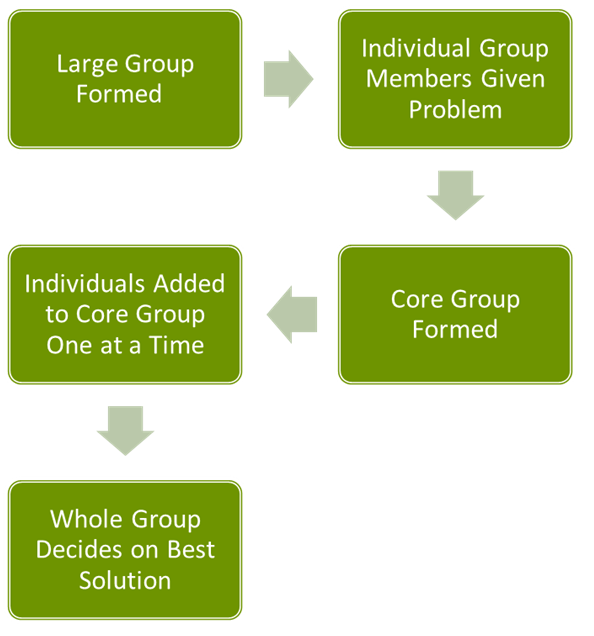
Here is a breakdown of the flow chart presented above.
- The group working on an issue is formed.
- Each individual group member is presented with the problem. They are given time to think about the issue and are expected to create potential solutions.
- Out of the group members, a core group of two members from the larger group is formed. These members begin discussing the solutions they have created.
- A third member is added to the core group. This third member presents their solutions to the first two members. Only after the new member has presented their ideas can the whole group talk about possible solutions. This process repeats until every individual member of the group is assimilated into the larger group.
- Once all members have presented their ideas, the whole group can decide on the best solution.
Brainwriting
Brainwriting is similar to the brainstorming creativity technique. Both approaches are used to create ideas in the effort to solve a problem. However, the difference between the two is the process through which the ideas are generated.
Brainwriting has taken the basic principles of brainstorming and enhanced them to guard against some of the downsides of group brainstorming, such as members of the group taking over the session or members not contributing. These drawbacks can affect the group’s decision as great ideas may be overlooked or a decision may be arrived at too hastily. In the effort to get more ideas generated, brainwriting was born.
Here are the steps for conducting a brainwriting session.
- Write the problem on a whiteboard or flip chart paper.
- Give each member of the group a piece of blank paper. To make this a little more fun, each member could also be given a large, oversized sticky note to write on.
- Nominate one member to be the chairperson.
- For the next five minutes, each group member will individually write four ideas on how to solve the problem. No discussion should be allowed, but can take place after ideas have been generated. (Get the chairperson to keep track of time for this step.)
- After the five minutes have elapsed, the chairperson collects the papers, mixes them up, and distributes them (so that each person now has another group member’s sheet).
- The chairperson will give the group five minutes to write new ideas or to build upon the ideas already written.
- Steps 5 and 6 are repeated as many times as necessary.
- When finished, whole group discussion takes place. The solutions presented by group members should be posted for all to see.
Brainwriting allows all group members to contribute equally. As well, because ideas are written, certain quieter group members may feel more comfortable sharing their ideas and more ideas may be generated than in a discussion setting. When the process is silent, group members have the ability to focus solely on their own thoughts without worrying about repeating an idea, forgetting an idea, or feeling embarrassed by sharing an idea.
Furthermore, more ideas are generated in terms of volume. In a traditional brainstorm, one idea would be shared at a time. With brainwriting, you have multiple ideas being written at the simultaneously. Not only does brainwriting generate more ideas, it generates them faster.
The Slip Writing Technique
About the Slip Writing Technique
The Crawford Slip Writing technique was developed in the 1920’s by Dr. C.C. Crawford, a professor at the University of California. This method of idea generation is similar to brainstorming, but instead of a discussion, it uses pieces of paper to capture ideas from a group. The Crawford Slip Writing technique was designed for use with large groups of 50 – 5000 or even more!
Since dealing with such large numbers can be overwhelming, Dr. Crawford sought to invent a technique that would offer organization while allowing each group member their say and an equal chance to contribute.
The Crawford Slip Writing Technique Model
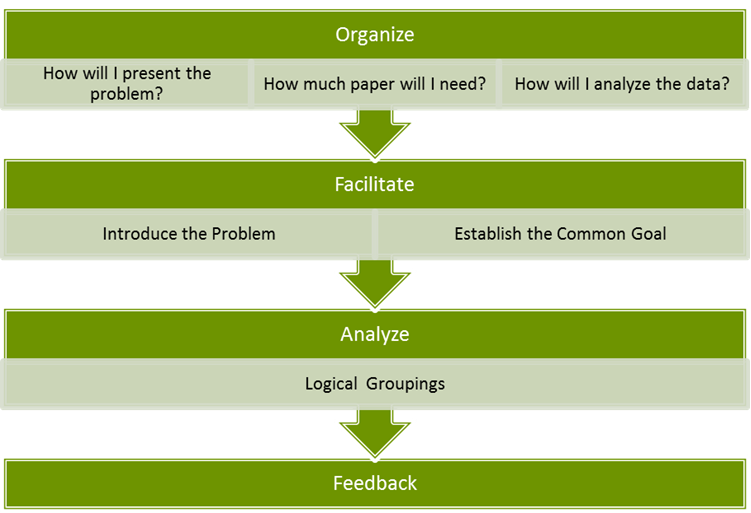
As you can see from the flow chart, there are four main steps in this model.
Organize.
Since you are dealing with a large group of people, you need to organize and prepare effectively. You need to figure out how you will present the problem to the group and how you will analyze the large volume of data collected from the group. Have ample pieces of paper or sticky notes ready; estimate about 30 per group member. These will be distributed to each member before the problem is presented.
Facilitate.
Introduce the problem to the group in a clear and concise way. It is vital that everyone understands what is expected of them. Establish the common goal by informing the group that the objective here is to get as many solutions as possible. Let people know that each idea must be written on its own piece of paper. Advise them to write down as many ideas as possible. The facilitator will use their discretion and end the idea generating session when writing slows. At the end of the session, inform the group that feedback on the session will be given soon after the data has been analyzed.
Analyze.
Sort data into groups that are logical depending on the nature of the problem that needs solving. For example, if your company is looking to create a service in order to break into a new market, you could organize your data into the following categories: market research ideas, advertising ideas, new service ideas etc.
Feedback.
As a professional courtesy and sign that you value the contributions of participants, feedback should be given as soon after the session as possible. If possible, this feedback should include the direction decided upon.