
SESSION EIGHT: THE THREE-STEP CONFLICT RESOLUTION MODEL
It’s time to get down to business now. We’d like to share three simple steps that you can use to manage your own dealings with difficult people. This is really about formatting and hosting a conversation.
In this session, you’ll learn how to apply the three steps of our conflict resolution model. You will also get some practice dealing with your personal difficult person.
The Three-Step Model
There are lots of models that can help us deal with difficult people and the conversations that come with them. They range from about three to eight steps, and our in-house trainer has scrutinized the best of them for you. We’ve found that you can be successful with any of the models provided that you apply all of the steps consistently. Leaving out steps can cause the conversations or the action plan to go off track.
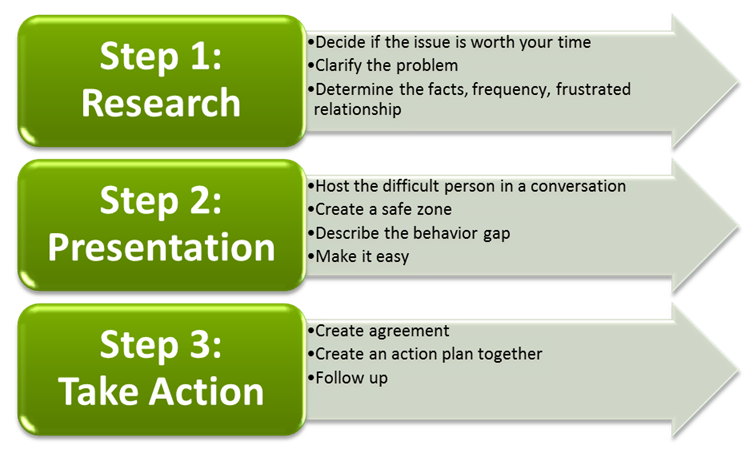
Step 1: Research
We have covered the elements for Step One in Session Five.
Step 2: Presentation
This is where you will invite your difficult person into a conversation. In doing so, it is important to create a safe zone for the conversation to take place. A safe zone is a place where other people cannot eavesdrop on your conversation. (Tip: Use a meeting room if you do not have an office.) It is also a zone where you, as host, need to feel safe. If history says that this individual is unpredictable, you may want to have an HR consultant or union representative present.
It is important that any guests to the meeting are there to simply observe and take notes, and that the conversation is between only you and your difficult person if possible.
The safe zone is also about trust and respect. If there is no mutual respect between you and your difficult person, you may have to take time to establish a few rules at the beginning of the meeting. For example, “We will control our tempers and language during the conversation,” means that you start with an agreement to treat each other respectfully.
Next, you describe the behavior gap using the facts, frequency, and frustrated relationship language that you learned in Step 1.
Finally, you must make it easy. This may seem like a Zen statement and also bother some of you, but it is also the sign of a very competent leader. Make the conversation easy on them and make it easy for them to comply with your requests. If there are barriers to the difficult person improving, your job is to remove those barriers. If they are having trouble getting motivated, your job is to help them find the motivation within and work with it.
There is nothing helpful or noble if you make things harder for people, so take this step seriously. (You’ll see that it works great with teenagers, too, if you happen to have any!) Explore the barriers together. Ask the individual what they think they can do and what is possible. Don’t follow your natural tendency to tell them what to do or to give tasks they don’t want to someone else. The work still has to be done. Your role is to enable them to do it, and do it to the best of their ability.
Step 3: Take Action
In order to make sure the gap raised in your conversation gets dealt with, you will need to create an action plan. These action plans are no good without the difficult person’s agreement to deliver. You’ll also need to set up a follow up timetable (daily, weekly, or monthly check-ins) to make sure they have what they need and can deliver.
If the action plan is not followed to the letter, then you’ll know that it is time to take things to the next level. This might mean that you must start career-altering conversations with your difficult person. Those second-level conversations are rarely needed when you determine that your action plan is appropriate and that you and the difficult person had the tools to succeed.