
SESSION FOUR: DISCLOSURE
It can be difficult to know how much information to share with clients. When a client talks about a recent family tragedy, should you share your own recent, similar experience? How do you know what is appropriate to share?
In this session, you will learn about what disclosure is and how it can help you build stronger relationships. You will think about how you can become more self-aware and identify some characteristics about yourself that fit within different parts of the Johari window.
Disclosure
Disclosure is the degree to which we are willing to be authentic with others and share appropriate information about ourselves. The idea here is that the more authentic we are, the stronger our relationships will be.
There are two significant ways of becoming more self-aware. The first involves listening to yourself to understand what causes your reactions or feelings and to look at how you react. We have a tendency to ignore our reactions to people and the world around us, but we can make our feelings and reactions more conscious if we raise our awareness and work on these things.
The second way to become more aware is to ask for feedback from other people about how they see you and how they react to your behavior.
To further our understanding, we’ll use the Johari Window concept, which was developed by Joe Luft and Harry Ingham.
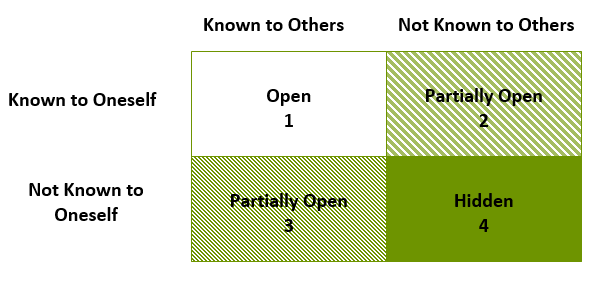
Understanding the Johari Window
When we raise our self-awareness and we get brave and ask feedback of others, it can help us become more authentic in how we communicate and interact with people.
The window illustrates the point that there are certain things you know about yourself and certain things that you don’t know. Similarly, there are certain things others know about you (that you may or may not know) and then there are things that don’t know.
One assumption of the Johari Window is that it takes energy to hide information from yourself and others, and that the more information is out in the open, the better and clearer communication will be.
Building a relationship often involves working to expand your open/free or “known to self and others” window, while decreasing your blind and hidden areas. As you become more self-disclosing, you reduce your hidden area, and give other people more information to work with, thus reducing your blind area.
As you encourage others to be more self-disclosing with you, your blind area is further reduced. As you reduce your blind area you increase self-awareness and this helps you to be even more self-disclosing with others.