
SESSION SIX: WORLD CAFÉ
There are many different models that you can apply to tap into the best of people and learn what they think. World Café is a powerful, effective model that encourages input from all levels of ability and function within an organization.
In this session, you’ll learn how to set up a World Café as an example of your ability to bring conversational leadership to life in your organization.
Setting Up
Setting Up the Café
Let’s set up an imaginary café. First, we need to give it a title. If you already have a pressing question or need among your group, use that. If not, here’s an example for you to live out. In this imaginary café, we’re sharing the spirit of individual reflections through some creative license from real cafés.
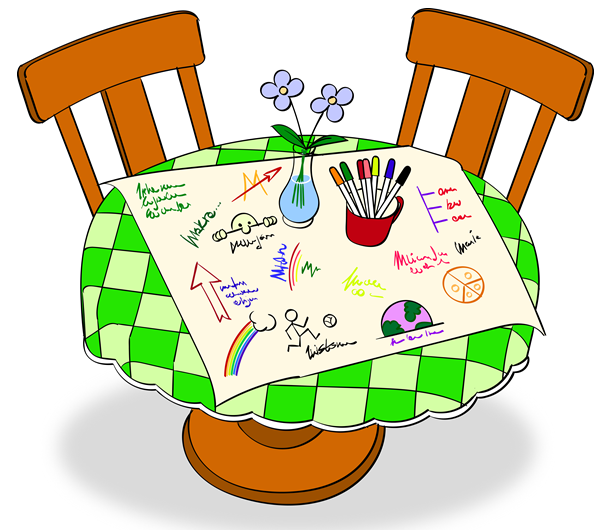
Imagine that the room is set up with small, café-style round tables. There are chairs for no more than four people at each table. Just like any café, there is a small vase with a tiny bunch of flowers, or maybe just one flower, and a checked tablecloth. There is also a cup full of felt markers and a newsprint tablecloth on top of the fabric cloth.
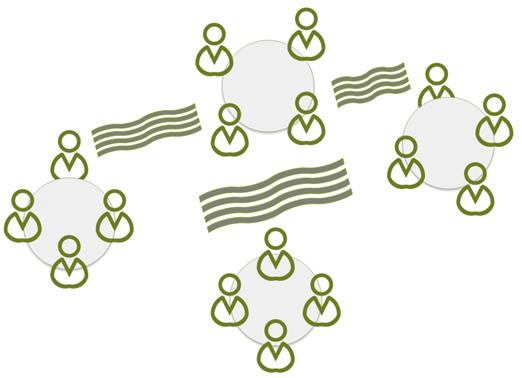
You can host a World Café for twelve people or 1000 people. The concept includes the notion that there are conversations at the table, and then people move to new tables. Ideas are shared and more ideas are created, and then people move to new tables again. This is why people say that in a World Café, conversations take place at the tables, but the magic happens in the spaces between the tables where energy, innovation, and ideas coalesce.
Round 1: Starting the Conversation
The host starts the conversation by saying something like this:
“Welcome to our café on <the topic at hand, such as values>. Let me start by introducing how we will get started today. We’re going to have three rounds of conversations. As your host, I will let you know when each round is coming to a close. One person will stay at the table as a table host and will welcome new guests to the table, who are coming from a conversation at their previous table. With them, they’ll bring the ideas from their previous table. At each table it’s important to capture the essence of what’s been said on your chart paper. You’ll link and build on those ideas.
“Let’s start with the question I have ready for you: What are you learning about the use of questions as a way to engage collaborative learning and collective wisdom that could be of help to someone?
“Now, some of you know each other and some don’t, so please introduce yourselves at your tables before you jump in.”
The introductions begin, and the conversations unfold. Participants will start sharing their insights about the question. That leads to questions that participants politely and positively ask of themselves, and each other. They will most likely discuss the definition of values and identify the company values as they currently exist. They’ll ask questions about what’s changed, or could change, and what that means to them. They can record key thoughts and ideas on the tablecloth.
Depending on the size of your group, you might leave them to their conversations for 15, 20, or 30 minutes. The longer you can leave them, the deeper their conversations will be.
The Innovation Space
Round 2: Connections Start
When it’s time to move to other tables, invite one person to stay at each table as the host. Introductions need to be made again. The table host will encourage participants to refer to the notes that have been made on the tablecloth already, and to continue adding to those notes as they engage in conversation about the topic question. As participants look at the tablecloth, it will spur them to make comments, and the conversation continues. They can add their thoughts to the work in progress on the tablecloth.
You can have as many rounds of conversations as are necessary, with participants moving between tables.
Round 3: Back to the Beginning
The café host will invite everyone to return to their original table, and to spend a few minutes sharing how the conversation evolved as they moved to other tables. The table host can ask, “What is it that we don’t know yet at this table?” and encourage people to continue sharing. Then they can ask, “What deeper questions do we still have about <topic>?”
The table leader will help participants develop a sense of the two or three questions that everyone feels are really important. Have a person volunteer to be the recorder, and to write each questions on its own large sticky note.
Round 4: Conversation of the Whole
Once the sticky notes are ready, the café host will open up a conversation of the whole to see what is emerging in the middle space; that moveable, energized, creative space that exists between all the tables. The host will also gather all the sticky notes, post them in an appropriate location, and help the group bring their thoughts together.
Remember that you are focused on working with questions. Even problem statements (“No one in this company knows what the company values are.”) are re-worked as questions (“Why don’t our employees know what our values are?” or, “How can we make sure that employees work in alignment with our values?”).