
SESSION FOUR: THE PROBLEM-SOLVING MODEL
Using a model will help people solve problems in an effective way.
In this session, you will learn about a three-phase model that you can apply to most problems. You will also have an opportunity to apply the model to two case studies.
Model Overview
Whenever you read a book on problem-solving, this model, in some form or other, is sure to be there. It may have six steps rather than seven, or it may have five steps. However, the model does not really change… just the authors’ ways of breaking it down.
As you work your way from problem to solution, you are actually shifting your focus.
- When you define a problem, you ask yourself: What is my problem?
- As you try to analyze the root causes you ask: Why is it a problem?
- When you are generating options, you ask yourself: What are some ways I can solve my problem?
The Problem-Solving Model
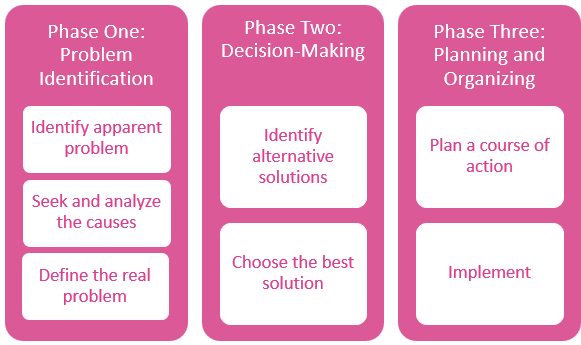
This model does not just work on paper: it applies across a range of problem-solving activities. It is the very basis for informed and consistent problem-solving. If you are someone who loves tools, this is your basic tool.
We often do not spend enough time in defining a problem, and that in itself is a problem. Do not be in too big a rush to get the solution worked out: make sure you know what you need to know. Then, make a commitment to continually check back with the first stage to make sure the problem is the same.
Another Perspective
Here is another way of breaking down the three phases:
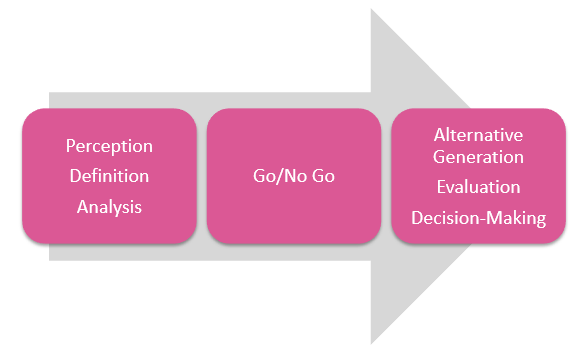
We recommend that you spend most of your time on the first block: perception, definition, and analysis. As we have mentioned already in this course, we often do not spend enough time in defining a problem, and that in itself is a problem. Do not be in too big a rush to get the solution worked out: make sure you know what you need to know first. Then, make a commitment to continually check back with the first stage to make sure the problem is the same.
Keeping an Open Mind
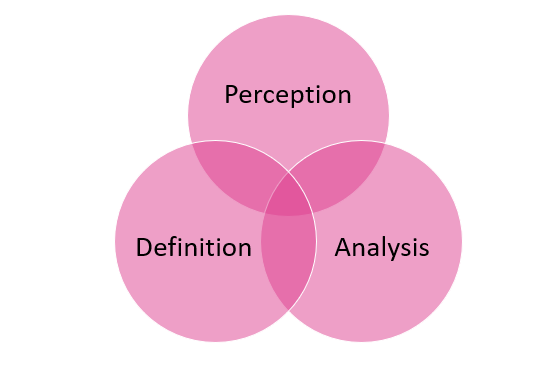
Part of the problem-solving process is re-evaluating and evolving. This will ensure you reach the best solution possible. Consider how perception, definition, and analysis overlap:
Phase One
Let’s take a look at the first phase of the three-phase model: Problem Identification. Here is a breakdown of each step in the problem identification process. In all three steps, your focus is on the problem itself. Only afterward will you start thinking about solutions.
Perception
You ask yourself: Is there a problem? Where is the problem? Whose problem is it? This is the sniffing, groping, grasping stage. It includes whatever you need to do to get a handle on the problem.
What are the symptoms? Funny noises in the engine, an unhappy look on your employee’s face, or a change in the productivity rate? You have to find out what the problem is.
The purpose of this phase is:
- To surface an issue.
- To make it okay to discuss it (legitimize).
- To air different points of view.
- To avoid perception wars.
- To get group agreement to work on the problem.
Steps in this phase include:
- Legitimizing the problem; make it okay to discuss it.
- Asking, “How does the problem feel?” and, “What is the real problem?”
- Identifying the best, worst, and most probable situation.
- Identifying whose problem it is.
Definition
Here, we state the problem as a question. Our goal is to grasp the general idea of the problem and then draw the rope tighter to get a more specific idea of the problem.
Steps in this phase include identifying:
- What is the problem?
- What is not the problem?
Analysis
Now that we have a general idea of the problem, we will use analytical tools to define it even further. Steps in this phase can include the following.
Ask basic questions, such as who, what, where, when, why, and how.
Break it down into smaller pieces. For example, if we know that the problem is that revenue has decreased, we can break it down into possible areas of cause: manufacturing, shipping, or sales.
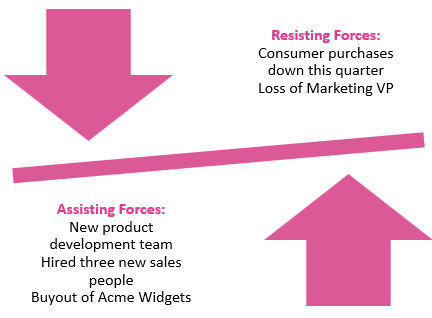
Use force field analysis. This is a structured method of looking at two opposing forces acting on a situation. Simply draw a line on a piece of paper. On one half of the line, list the forces that are working to solve the problem. On the other half, list the forces that are stopping you from solving the problem. Let’s say that revenue is down this quarter. Our force field might look like this:
Move from generalizations to specific examples as a way of testing what the problem is or is not. For example, you could say, “Our company has really been doing poorly all year.” We could further identify how the company has been doing poorly; let’s say that the production department in particular has been less efficient, costing the company money. Then, we can look at what aspect in particular is doing poorly.
Ask the expert. Find a person who has dealt with this sort of issue before.
Phase Two
Until the three steps of problem identification have been covered, do not proceed to phase two (decision-making). (If people do not agree on the problem, they will never agree on a solution!)
Creative Thinking Methods
Here are some tools you can use to come up with ideas.
Brainstorming
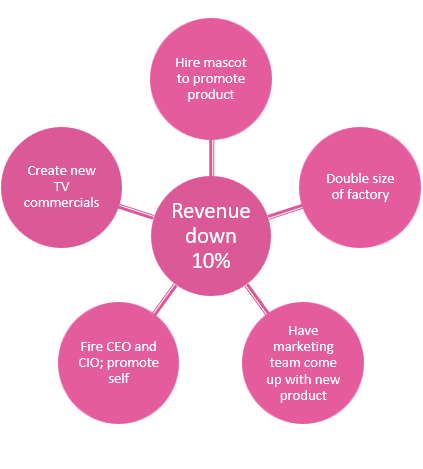
Draw a circle in the middle of a page and write down your problem. Then, draw lines from that circle and write down some solutions. Do not worry if they are wacky, impossible, or silly; this is a time for creative thinking, not critical thinking. Capturing the range of ideas is what is important here.
Checkerboard
This is a more organized form of brainstorming and can be particularly helpful for people who do not like how chaotic a brainstorming session can become. With this method, you organize your thoughts into a table. We still want creative thinking rather than critical thinking, but this method may help you develop ideas.
Here is an example of a checkerboard.
| Main Solution | Possible Specific Solutions | ||
| Create safe passage between building and parking/bus stop | Have security escort night staff to their cars or bus stop | Rearrange shifts so that people come and go during daylight hours | Set up a buddy system with employees |
| People missing work in snowstorm | Set up 50% of staff with ability to work from home during storms | Arrange for temporary shelters so that staff can stay overnight | Provide incentives for employees to put winter tires on their vehicles and learn safe winter driving |
| Threat of strike is rumored | Set up contract negotiations well before contract expires | Approach union and ask to speak with them | Set up contingency plan to ensure business continuity in the event of a strike |
Next, cut up solutions and move them around, or use your computer. This can help you organize your ideas and generate even more solutions!
Research and Report
Look at what others have done. Do some research and prepare a report. What lessons can you learn from this information?
Evaluation
Now that we have some solutions in mind, it is time to evaluate the solutions to see which ones are feasible.
- Sort solutions by category. This can be similar to the checkerboard above, just with some critical thinking applied.
- Identify the advantages and disadvantages to each solution.
- Identify what you like about each idea and what you do not like.
- Number your ideas in order, from the one that seems the most feasible to the one that seems the least feasible. This is useful for small problems.
Decision-Making
Once you have evaluated the options, it is time to make a decision. Here are some ways you can do it:
- Get a consensus from the group on the best solution.
- Do not limit yourself to one option; you may find that you can combine solutions for super success. (This is called the both/and method.)
- To make voting easier, you may want to eliminate the solutions that the group as a whole absolutely will not consider.
- Try to focus on agreements during all voting.
- Use straw voting: Take a quick, non-binding yes/no vote on the current solution as proposed.
- Try negative voting: Rather than asking who is for a solution, ask who is against the proposed solution.
- Back off! The group may need some time to evaluate the options before making a decision.
Phase Three
Our last phase should be planning how to implement the solution and performing the actual implementation.
Planning
For the planning portion, start by breaking the task down into smaller portions. Then, for each mini-task, plan the following information:
- What needs to be done?
- Who will do it?
- What resources will we need?
- How much time will it take? (Set a deadline!)
Once all the smaller tasks are planned out, you will have an idea of how long the main solution will take to implement. You may also want to make sure that the above questions are answered for the main task.
Implementation
Implementation is a cycle of three activities:
- Figuring out what you are going to do
- Doing it
- Reacting to what happened or getting feedback
Sooner or later, you have to try out your solution!
Solution Planning Worksheet
It can help to lay out what you are planning to do. Here is an example of a solution planning worksheet.
| Problem: | Revenue down 10 per cent | ||
| Solution: | Develop new product | ||
| Task 1 | Engineering will design product. | ||
| What needs to be done? | Product needs to be designed. | ||
| Who will do it? | Jim and Sue from Engineering. | ||
| What resources will they need? | Unknown. They should have all resources in house; we will make sure they know we can assist in obtaining more resources if necessary. | ||
| How much time will it take? | Targeted completion date: Dec. 31 | ||
| Task 2 | Prototype will be created. | ||
| What needs to be done? | Prototype needs to be developed. | ||
| Who will do it? | Sam from Manufacturing, Jill from Engineering | ||
| What resources will they need? | May need testing group; we will help provide this | ||
| How much time will it take? | Targeted completion date: Feb. 28 | ||
| Task 3 | Product will be manufactured. | ||
| What needs to be done? | Product needs to be created. | ||
| Who will do it? | Joe from Manufacturing | ||
| What resources will they need? | All resources in-house | ||
| How much time will it take? | Targeted completion date: Dec. 31 | ||