
SESSION EIGHT: MAKING GOOD GROUP DECISIONS
In business organizations, decision-making often involves more than one person.
In this session, you will learn about some things that are essential for team problem solving. Other decision-making tools are also explored.
Working Toward the Decision
You can use several tools that will help strengthen group decision-making.
In your workday you deal with two kinds of decisions: the routine and the strategic. In a routine decision, the conditions of the situation which the solution has to satisfy are known, and the job is simply to choose between a few obvious alternatives. The routine decision is often governed by which alternative will accomplish the goal with the minimum effort and disturbance.
Strategic decisions are more complex. They involve either finding out what the situation is or changing it. The ramifications of strategic decisions are broader; they can affect productivity, organization, capital expenditures, and so forth.
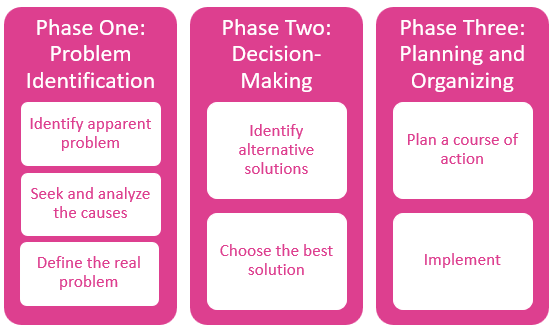
Remember the tools we have talked about so far, including the three-phase model we introduced in Session Five. These tools can be used for both types of decisions.
The Three Phase Model
Decision Frames
There are many formats for decision frames, and lots of names. Essentially, this is a graphic representation of the decisions that the group is making. It provides a format for thinking through the process and allows decision makers to consider the likelihood of each possibility. Sometimes these decisions make use of formal shapes involved in flowcharting, although for shorter decisions a series of drawings on a flip chart will suffice.
The decision tree below is one team’s consideration about whether to purchase new smartphones or tablets for the production team at a particular workplace. The first dot raises the question ‘smartphone or tablet.’ Subsequent dots will highlight the decisions made through the process, weighing out factors such as usability, cost, service charges, practicality, applicability to work, etc.
Stepladder Technique
This is a useful technique that encourages individual participation within a group. This technique encourages people to contribute on an individual level before they can be influenced by anyone else. This method will encourage a wide variety of ideas and stops anyone from withdrawing or hiding within a larger group. It also avoids having some personalities overpower others because, with this technique, all members of the group are equal. People will not want to engage in this method if one person has an agenda and pushes it on the others. This technique is very effective for smaller groups (four to seven members).
There are five steps to this technique.
- Group members are presented with the problem and given time to think about it, do some research, and form their own opinions about what could be a reasonable solution.
- Two members of the group are assigned to discuss the problem. They meet and discuss their ideas.
- A third member is added to the group and presents their ideas before hearing the ideas that the first two have discussed. After all three have presented their ideas, they discuss the options together.
- The process is repeated by adding one member to the group at a time. Remember to allow discussion time as each person joins the group. Be careful here, since the first members of the group may drift off. Keep the group small enough that everyone can remain engaged.
- Once presentations and discussions are finished, the group makes their decision.
The Delphi Technique
This technique is very useful when you have people who are considered experts on a topic and when you are looking for information to help with forecasting or resource allocation. This technique works by using cycles of anonymous, individual written discussion and argument, and is coordinated by a facilitator.
Anonymity and remoteness of the process (which could also be managed using an online survey tool) helps to avoid personality issues and groupthink. It also gives people the opportunity to think things through on their own time, to consider other arguments adequately, to gather any background information that is required, and avoid the emotional energy that can be generated during an in-person debate.
The process requires an effective and strong facilitator. One of the weaknesses to the method is that participants are not always provided with adequate background information, and sometimes when the information is made available, the experts do not access it. The facilitator has to make sure that participants are engaged and that they do not put off responding.
Nominal Group Technique
When a group meets, it can sometimes be difficult to get heard above the rallying of people who are loud or have more status in the organization. When it comes to gaining consensus on important decisions and priorities, the nominal group technique is a great help.
This is a face-to-face process often used in organizational planning where people with competing priorities need to come to agreement in order to assign resources and money.
The group must be provided with and discuss the issues before the evaluation takes place, with each group member having an equal voice. Each participant will nominate their priority issues and rank them on a scale.
As an example, the IT Development manager compiles a list of requests from different sections within the company, which includes items such as: updating software, creating custom programs, purchasing hardware, and fixing bugs in existing systems. Naturally, the manager has a budget that restricts the amount of work that can be done each year, and which dictates the resources that are available.
In order to work with her colleagues, the manager understands the value of having those people who contributed to the list decide what the priorities are. She invites her colleagues to a meeting where they will discuss each item on the list, and then assign it a priority order for completion. An added benefit of these discussions is that the managers involved get a very thorough understanding of competing and complementary priorities throughout the organization.
Avoiding Fatal Mistakes
Groupthink
If you have ever been part of a group where people hesitate to speak up, or you led a team (or a meeting) where people would not speak up, you may have been experiencing groupthink.
Groupthink occurs when the goal of consensus overrides people’s responsibility to speak up. It can occur at the end of a workshop, where at 4 p.m. the trainer asks if there are any questions. Somebody may have a question, but they hesitate to ask because they know that other participants are keen to leave early that day. The question goes unasked, people leave early, and everyone but the person with the question is happy.
Fighting the Status Quo
Sometimes, despite all of our best problem-solving and decision-making, we run into a brick wall. Although we know change is good, inevitable, and that we have some terrific ideas that will solve our troubles and generate money, the familiar is easy. Maintaining the status quo is not going to require late night planning sessions, new processes, equipment, or money. The status quo might be ugly, but it is familiar. In a world where we are constantly required to work already, people and companies are happy to maintain the status quo. It is also not going to add work to our busy, overworked to-do lists.
If you are fighting the status quo in getting decisions implemented, you need to phrase your business case in a way that presents the benefits of the change to the people who must implement it, and you need their cooperation. Time is a precious commodity. It is often not that people fear change as much as they fear the commitment that comes with it.
Change must be worthwhile if people are going to come on board, so make it worth their while. Change should not be implemented just for the sake of changing; it must somehow have a positive effect.
Other Decision-Making Tools
New, Appeal and Feasibility (NAF) Technique
NAF is a method to score ideas in Group Decision-making to select ideas worth pursuing.
The process goes as follows:
First
- Identify a current work-related problem.
- Generate a number of ideas as potential solutions (through brainstorming, brainwriting, etc.).
- Write each idea on a blank file card.
- As a group, remove duplicates and merge similar ideas to end up with a set of unique file cards.
Next
- Consider one idea/card at a time.
- The group leader reads out each idea/card to the group.
- The group then votes.
Voting
- Each person writes their score for each category on a separate card which will act as their vote and passes these in to the group leader.
Sample Score Card
| Idea
| |||
| Scale (1 to 10) | Score | ||
| New | 1= very old | 10= brand new | |
| Appeal | 1= not appealing | 10= very appealing | |
| Feasibility | 1= not feasible | 10= very feasible | |
| Total | |||
Scoring Ideas
- The group leader averages out the scores from the entire group vote.
- The group leader leads a discussion about the ideas with the top aggregate scores.
- The group comes to a consensus about the final decision.
Visualization
Most methods of group decision-making revolve around words. This can limit creativity for some in the group. As well, especially if the group making decisions has been bogged down by meetings, discussions, brainstorming and the like, visualization can be a great change.
By using drawings and diagrams, a problem can be described in a different way. Examples of problems that can be helped through this method include:
- Designing new driving paths through a parking lot
- Visualizing what a company might look like in 10 years
- Deciding on what benefits will be included in the company’s benefits package.
The process goes as follows:
First
- Identify a current work-related problem.
- Using large sheets of paper have each person draw the problem and visualize it.
- Remind them to be creative.
Next
- Gather the group together in small groups of two or three.
- Have them share their visualizations.
Then
- Ask each group to write a short narrative explaining the problem and their potential solutions.
- Have them present this to the rest of the group.
Finally
- Have a discussion and come to a consensus about the final decision.
Benefits Possibilities Concerns (BPC) Technique
Much like NAF that we looked at earlier, BPC is a method to score ideas in Group Decision-making to choose ideas worth pursuing.
The process goes as follows:
First
- Identify a current work-related problem.
- Generate a number of ideas as potential solutions (through brainstorming, brainwriting, etc.).
- Write each idea on a blank file card.
- As a group, remove duplicates and merge similar ideas to end up with a set of unique file cards.
Next
- Consider one idea/card at a time.
- The group leader reads out each idea/card to the group.
- The group then evaluates the ideas.
Evaluating
- Each person writes their evaluation for each idea (assessing Benefits, Possibilities, and Concerns) on a separate card.
Sample Evaluation Card
| Idea:
| |||
| Criteria | Your Analysis | ||
| 3 Benefits | |||
| 3 Possibilities | |||
| 3 Concerns | |||
Scoring Ideas
- The group leader reads out each idea and the group discusses the Benefits, Possibilities, and Concerns of each.
- After all ideas are discussed each person votes for their top three ideas.
Final Vote
- The top three ideas from the group are determined by the vote.
- The group comes to a consensus about the final decision.