
SESSION SIX: WHERE DOES CREATIVITY FIT INTO THE PROBLEM-SOLVING PROCESS?
Being creative is an everyday thing. We are faced with many decisions on a daily basis and some of our choices require a fair amount of thought. Practice, along with a thorough understanding how we solve problems, can help us boost our creative potential.
In this session, you will investigate the role of creativity within the problem-solving process. You will also explore how these concepts are linked.
Problem-Solving Models
The Problem-Solving Model
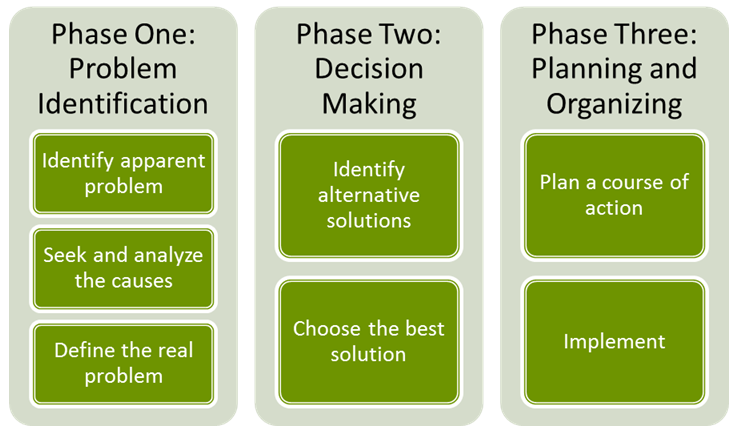
This process is the very basis for informed and consistent problem solving, and creativity is a key part of the entire model. Each phase is equally important: proper identification of the problem, creativity in identifying solutions, innovation in implementing solutions.
The first stage of problem solving involves proper identification of the problem. This stage is vital since it will enable you to generate the right solutions. Do not rush this stage: make sure you know what the problem is before you proceed.
The second stage involves creativity and the generating of ideas. This stage revolves around identifying your options and deciding which option will be the best to solve your issue.
The third stage involves innovation: making a plan and implementing the ideas generated in the second stage.
Another Perspective for Creative Problem Solving
Here is another model that we can use for creative problem solving:
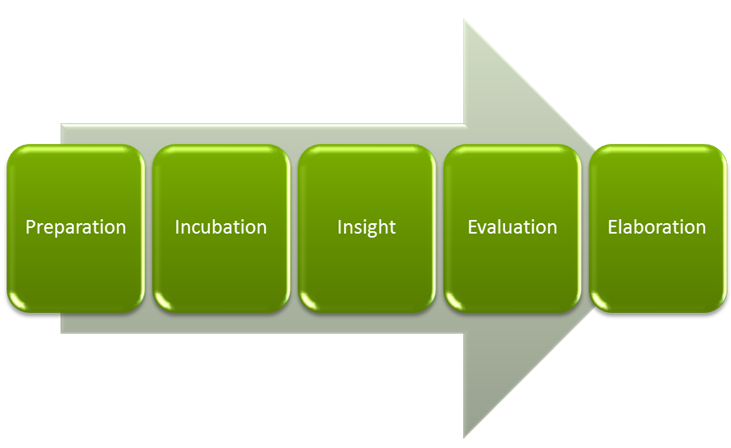
This model comes from Mihaly Csikszentmihalyi’s book Creativity: Flow and the Psychology of Discovery and Invention.
Here is a more detailed breakdown of the model.
- Preparation Phase: During this phase, we are becoming immersed in a set of problematic issues that are interesting or arouse curiosity.
- Incubation Phase: This phase is the percolation phase. Here we have ideas churning around in our heads. This is the phase when unusual connections between ideas can begin to emerge.
- Insight: This phase is the “Aha!” moment, as Oprah would say. It’s the time when the pieces of the puzzle come together.
- Evaluation: This is the phase when we must decide if the insight(s) made in the previous phase have any value. Are they worth pursuing?
- Elaboration: If our insights have value, we elaborate and act on them. This phase transforms our ideas into a plan. We take the abstract and make it concrete.
Keeping an Open Mind
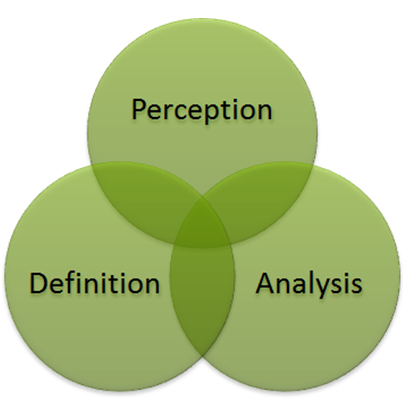
Part of the problem-solving process is re-evaluating and evolving. This will ensure that you reach the best solution possible. Consider how perception, definition, and analysis overlap:
Solving Problems the “Right” Way
There is no one “right” way to solve a problem. If there was, it would be much simpler to decide on a solution and apply it! With so many different kinds of problems to deal with, there is no system that works in every situation. Many solutions are possible, and some are better than others.
Your skill as a problem-solver depends on your expertise with the tools and your knowledge of how to use them. You know you don’t always solve problems step by step. Sometimes you have a solution before you know what problem it solves. (For example, you decide to move your bed against another wall and you find out the next morning that the sun doesn’t wake you up so early.) However, for many situations, having formal steps to follow can help you create flexible, workable solutions.
Phase One
Let’s take a look at the first phase of the three-phase model: Problem Identification. Let’s look at each of the three steps in this process. In all steps, your focus is on the problem itself.
Perception
You ask yourself: Is there a problem? Where is the problem? Whose problem is it? This is the exploration stage. It includes whatever you do to get a handle on the problem.
What are the symptoms? Funny noises in the engine, an unhappy look on your employee’s face, or a change in the productivity rate? You’ve got to find out what the problem is.
The purpose of this phase is:
- To surface an issue.
- To make it okay to discuss it (legitimize).
- To air different points of view.
- To avoid perception wars.
- To get group agreement to work on the problem.
Steps in this phase include:
- Legitimizing the problem; make it okay to discuss it.
- Asking, “How does the problem feel?” and, “What’s the real problem?”
- Identifying the best, worst, and most probable situation.
- Identifying whose problem it is.
Definition
Here, we state the problem as a question. Our goal is to grasp the general idea of the problem and then draw the rope tighter to get a more specific idea of the problem.
Steps in this phase include identifying:
- What is the problem?
- What is not the problem?
Analysis
Now that we have a general idea of the problem, we will use analytical tools to define it even further. Steps in this phase can include the following techniques.
Ask basic questions, such as who, what, where, when, why, and how.
Break it down into smaller pieces. For example, if we know that the problem is that revenue is down, we can break it down into possible areas of cause: manufacturing, shipping, or sales.
Ask the expert. Find a person who has dealt with this sort of issue before.
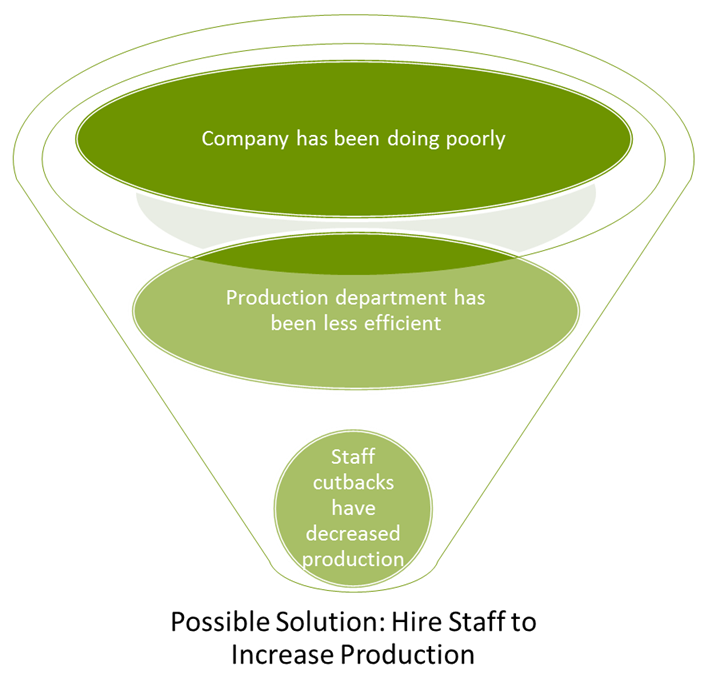
Move from generalizations to specific examples as a way of testing what the problem is or is not. For example, you could say, “Our company has really been doing poorly all year.” We could further identify how the company has been doing poorly; let’s say that the production department in particular has been less efficient, costing the company money. Then, we can look at what aspect in particular is doing poorly.
This analysis can be looked at in the shape of a funnel. We move from the top of the funnel (the general issue) to the bottom of the funnel (the specific issues):
Phase Two
The next phase of the problem=solving model (idea generation) involves a high level of creativity. Remember, you must have completed the first phase (identifying the problem) before you move onto creating possible solutions. As well, if the problem you are trying to solve involves group input, be sure that all group members agree that the problem has been accurately identified. If people don’t agree on the problem, they will never agree on a solution!
Creative Thinking Methods
Here are some tools you can use to come up with ideas.
Brainstorming
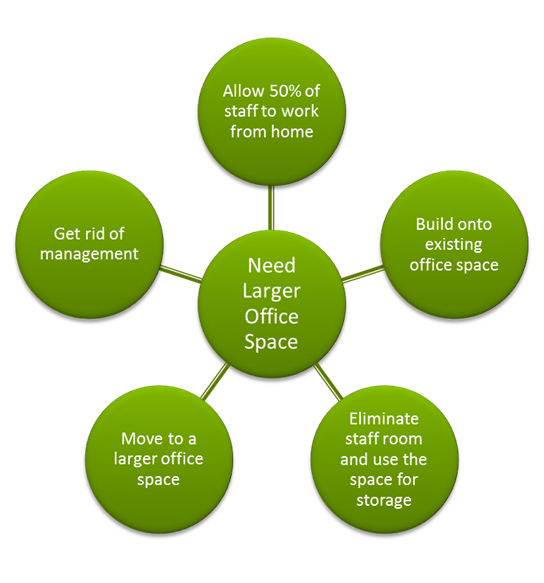
Draw a circle in the middle of a page and write down your problem. Then, draw lines from that circle and write possible solutions. Don’t worry if some ideas are unconventional; this is a time for creative thinking, not critical thinking. The purpose of this exercise is to capture the range of ideas.
Checkerboard
This is a more organized form of brainstorming and can be particularly helpful for people who don’t like how chaotic a brainstorming session can become. With this method, you organize your thoughts into a table. We still want creative thinking rather than critical thinking, but this method may help you develop ideas.
Here is an example of a checkerboard.
| Main Problem | Possible Specific Solutions | ||
| Roof at the office needs to be shingled | Have construction done in the summer to minimize the effect on the workplace | Have staff work from home | Arrange to have the roof worked on in the night |
| People are consistently showing up late for work | Dock their pay for time missed | Bring the problem to their attention | Provide incentives for good attendance |
| Colleagues are leaving dirty dishes in the staff room | Post a sign stating expected behavior | Speak to the people responsible individually | Assign a cleaning schedule for each day |
Next, cut up solutions and move them around, or use your computer. This can help you organize your ideas and generate even more solutions!
Research and Report
We do not have to reinvent the wheel. Look at what others have done. Do some research and prepare a report. With some investigation, you might just find the perfect solution to your problem. Or you might just learn what not to do!
Evaluation
Now that we have been through the creative process and generated ideas, it’s time to evaluate the solutions to find the best fit.
- Sort solutions by category. This can be similar to the checkerboard above, just with some critical thinking applied.
- Identify the advantages and disadvantages to each solution.
- Identify what you like about each idea and what you don’t like.
- Number your ideas in order, from the one that seems the most feasible to the one that seems the least feasible.
Decision Making
Once you have evaluated the options, it’s time to make a decision. Here are some ways you can do it:
- Get a consensus from the group on the best solution.
- Don’t limit yourself to one option; you may find that you can combine solutions for super success. (This is called the both/and method.)
- Eliminate the solutions that the group as a whole won’t consider.
- Try to focus on agreements during all voting.
- Use straw voting: Take a quick, non-binding yes/no vote on the current solution as proposed.
- Try negative voting: Rather than asking who is for a solution, ask who is against the proposed solution.
- Back off! The group may need some time to evaluate the options before making a decision.
Phase Three
The last phase involves innovation. We take the chosen idea generated from our creativity phase (Phase Two) and plan how to implement the idea. In addition to planning, we perform the implementation of the solution. After all, we have to try out our solution sometime!
Planning
For the planning portion, start by breaking the task into manageable chunks. Then, for each mini-task, plan the following information:
- What needs to be done?
- Who will do it?
- What resources will we need?
- How much time will it take? (Set a deadline!)
Once all the smaller tasks are planned out, you will have an idea of how long the main solution will take to implement. You will also want to make sure that the above questions are answered for the main task.
Implementation
Implementation is a cycle of three activities:
- Figuring out what you are going to do
- Doing it
- Reacting to what happened or getting feedback
Solution Planning Worksheet
It can help to lay out what you are planning to do. Here is an example of a solution planning worksheet.
| Problem: | Staff shortage | ||
| Solution: | Hire more staff | ||
| Task 1 | Hiring budget needs to be assessed. | ||
| What needs to be done? | Budget needs to be assessed to know how many people we can afford to hire | ||
| Who will do it? | Deborah from Accounting | ||
| What resources will they need? | All resources in-house | ||
| How much time will it take? | Targeted completion date: Dec. 31 | ||
| Task 2 | Establish company presence at local job recruiting fairs. | ||
| What needs to be done? | Contact people who run recruitment fairs and reserve a spot for our company | ||
| Who will do it? | Bill and Barb from Human Resources | ||
| What resources will they need? | Table, Chairs, Company Brochures, Applications, Decorations | ||
| How much time will it take? | Targeted completion date: March 1 | ||
| Task 3 | Advertise Openings. | ||
| What needs to be done? | Job advertisements need to be created and posted on company website | ||
| Who will do it? | Sheila from Human Resources and Bob from Tech Support | ||
| What resources will they need? | All resources in-house | ||
| How much time will it take? | Targeted completion date: Jan. 20 | ||