
SESSION EIGHT: CREATIVE TECHNIQUES
Depending on our level of familiarity with a topic, being creative can be difficult. When faced with a difficult situation, we need to be prepared and have a variety of strategies in our toolkit that can help us with idea generation.
In this session, you will learn about a variety of techniques to help with idea generation. You will also complete several exercises to reinforce the concepts.
The RAP Model
The RAP Model
Companies maintain a competitive edge by enhancing existing products and developing new products. To accomplish this goal, we need to train ourselves to think differently about our existing products and services. However, being faced with enhancing an existing product to create a new product can be quite a creative challenge. Enter the RAP model.
The RAP model has been designed to get you thinking about how to create new products and services from existing products and services. The model asks questions to help give focus to your thinking and to help you view a product in a different light. Here is a breakdown of the acronym and the questions associated with each of the concepts.
R: Replace
- What materials or components could you substitute to make a new product?
R: Remove
- How can you simplify your product and reduce it to its core functions?
- How can you make this product more efficient?
R: Reorder
- How can you change the order or rearrange the use of this product?
- What components could you substitute to change the order of this product?
A: Amalgamate
- What products or services could you combine to make a new product?
- What items can you integrate to create a new product?
- What components can you put together to maximize the uses of this product?
A: Amplify
- What features could you add to amplify this product?
- What components could you change to give this product a different look and feel?
- What components could you add to your product to give it more consumer value?
A: Alter
- How can you adapt this product to serve another purpose or use?
- What are others doing in your industry to adapt and change their products to the market?
P: Put to another use
- Instead of scrapping a product, would there be a way to use this idea somewhere else?
Case Study
An excellent example of the RAP Model at work is the invention of the sticky note. In 1968, Dr. Spencer Silver was attempting to develop a super-strong adhesive, but instead he accidentally created a low-tack, reusable adhesive. For years, Silver promoted his invention but had little luck finding a proper use for the product. In 1974, a colleague of Dr. Silver’s came up with the idea of using the adhesive to anchor his bookmark in his hymn book, and so the sticky note was born!
With the help of a colleague, Dr. Silver managed to create a new product from an existing product. The men altered an existing product and put an existing product to another use.
Summary
Use the questions in the RAP model as a guide to brainstorm potential ideas for developing an existing product or for creating a new product. Your goal in the brainstorming process is to generate as many ideas as possible. Do not eliminate ideas until you have exhausted the creative process. As you get comfortable using the technique, alter and add questions. Having the right questions to fit your problem can help the idea generation stage go much more smoothly.
The Shoe Swap Technique
Isolating your thinking to examine an issue can bring about great insight and perspective. Human beings can naturally jump toward a particular issue in both their thinking and feelings. They can move from being neutral to being optimistic in seconds. This “waffling” makes planning and coming up with ideas a difficult task, especially in a group setting where some people are uncomfortable speaking their mind. This is particularly common when there is conflict or competition among members of the group.
The shoe swap technique calls for members of a group to each play a thinking role. Each member selects or is given a pair of shoes that represents a role or certain style of thinking. The roles associated with each pair of shoes are based upon the six dominant thinking styles that emerge in group settings:
- The creative person
- The fact-based person
- The intuitive person
- The process-oriented person
- The devil’s advocate
- The people pleaser
The model below gives a breakdown of the shoes and what style of thinking each pair represents.
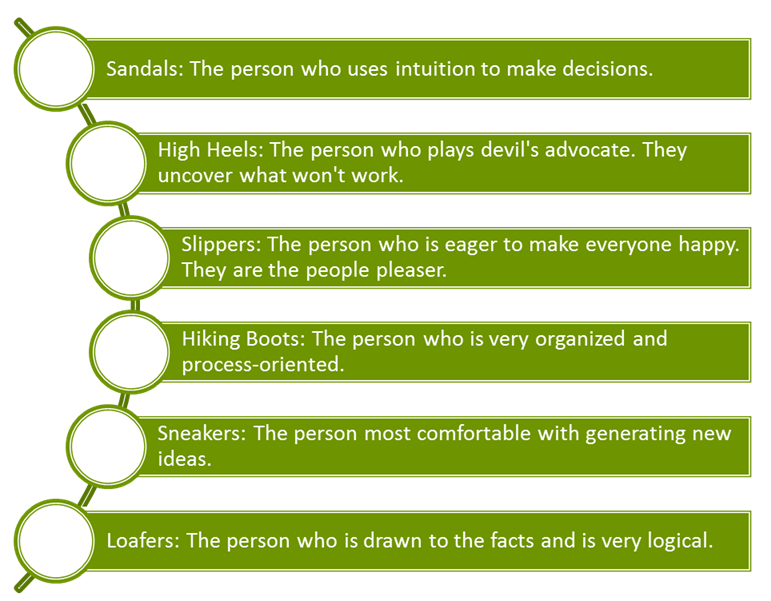
When employing this technique, it is important to note that certain people will better identify with certain roles. Although there are probably two or three roles that we can each identify with in some ways, most people tend to fit in one category or thinking style the best. Alternatively, there are some thinking styles that will bring people out of their comfort zone. For example, a person who likes to keep the peace and please others may find it slightly uncomfortable playing the devil’s advocate.
There are a variety of ways to implement this technique. You could have each person pick the role they are most comfortable with. If you know the group you are working with well enough, you could assign people roles they may not normally assume.
Stretching a person’s comfort zone can enable them to view things from a different perspective, but you don’t want to make people feel too uncomfortable. Make sure they are stretched just enough but not so much as to hinder the activity’s progress.
An additional approach would be to have all members of the group assume the same role at the same time. Once many ideas have been generated, have all the group members switch to another role.
This technique is useful for understanding different perspectives. Since the roles represent the six dominant thinking styles that emerge in group settings, role playing these styles can help give us great insight into how other people think. For example, if you are a loafer person (drawn to facts and very logical), you may find it very difficult to identify with and understand a sandal person (uses intuition to make decisions). This technique teaches you about other thinking styles and can give you a better understanding of why people act as they do.
Using Mind Mapping
Understanding Mind Mapping
Mind mapping is a creative technique that helps to organize a main idea and its major sub-topics. This visual aid helps the mapper break a complex idea down into manageable chunks.
Here is how to create a mind map.
- On a piece of paper, put your main idea at the center of the map. Try to limit the amount of words needed to describe your main idea. Be clear and concise to avoid unnecessary clutter on your map.
- Major sub-topics related to the main idea branch off from the main idea. Write or draw these sub-topics in a circular shape around your main idea. Draw a line between the main idea and the sub-topics to indicate the link between ideas. Again, use only a couple of words to describe your sub-topics.
- You can add another layer of information to your map by adding detail to your sub-topics. Write or draw this information around your sub-topics.
- The third step can be repeated as many times as required. This will give your idea greater focus and your map greater detail.
This technique is a great tool to help flesh out all of the parts associated with an idea. When something is written down, it helps to move the idea from being abstract to being concrete and can help you to feel less overwhelmed with your task. Additionally, visualizing the parts of an idea can help prevent overlooking something vital.
The physical layout of the mind map also lends itself to easily adding more information. As well, this technique can be as creative as you like. To add a little spice to your map, you can add drawings to represent the main idea and its sub-topics.
Creating a Mind Map
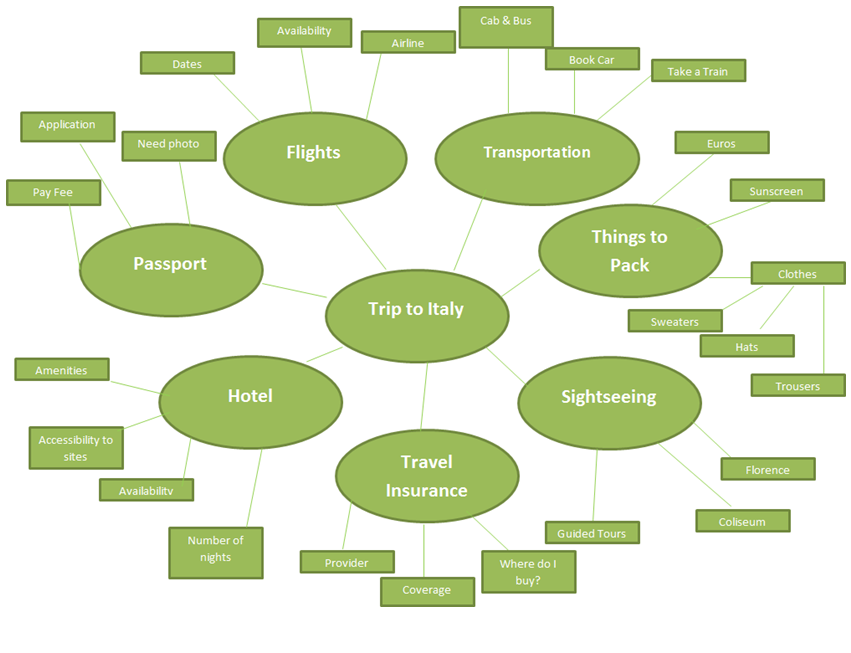
To help you fully understand the concept, here is an example of a mind map.
Step One: Write a list of the main topic and the sub-topics.
Main Topic:
- Vacation to Italy
Sub-Topics:
- Get Passport
- Flights
- Hotel
- Sightseeing
- Things to Take
- Travel Insurance
- Transportation
Step Two: Begin constructing your mind map. Place the main topic at the center of your map. Place your sub-topics in a circular shape around your main topic. Use lines to show the relationship between your main topic and sub-topics.

Step Three: Enhance your mind map by adding relevant information to your subtopics and modifying them as needed.
Metaphors and Analogies
Defining Metaphors and Analogies
Metaphors and analogies can be great tools for sparking creativity. A metaphor is a figure of speech that compares two unrelated objects. A simple equation for creating metaphors is “The (first item) is a (second item).” Examples:
- His mind is a prison.
- My hamster is a king.
An analogy is a figure of speech that compares two unrelated objects in order to show a point of similarity. Here is an example of an analogy: “In life, you need to take the old out of your backpack in order to put the new in. Sort through the tools you have, keep the ones you need, and leave room for ones to develop.”
The analogy between the contents of a backpack and personal development tries to emphasize that personal development is a continual process of evaluation. Just like carrying a backpack, you cannot carry everything and you must evaluate what tools are important for you on your journey.
While metaphors and analogies may seem similar, they are not. Remember, a metaphor compares two unlike objects. An analogy compares two unlike objects in order to show a point of similarity.
Using Metaphors and Analogies to Express Ideas
Using metaphors and analogies can be a great creativity exercise as they help us view a concept through a different lens. By looking at these objects in a different light, we create the opportunity to forge unexpected connections. Additionally, metaphors and analogies paint a descriptive picture of a concept. If a concept is particularly difficult to understand, it may be easier to grasp if it is reframed using one of the above techniques. For example, saying “The heart of the car is its transmission” is a lot easier to understand than explaining how other parts of the car (such as the alternator, pistons, sensors) would not function without the transmission working properly. The beauty of this metaphor is that even if we know nothing about transmissions, instantly we have some insight into how vital this part is to a vehicle.
One point to remember when using metaphors and analogies is to make sure your audience will understand the references. When someone hears a metaphor or analogy, the message being sent should automatically ring true. If you use obscure references unknown to your audience, your message will fall flat. Using a well-known metaphor like, “Time is money” will probably resonate more with your audience than saying, “Making money is a Sisyphean endeavor.”
Situation/Solution Reversal
The Process
The situation/solution reversal is a unique approach to brainstorming. To use this technique, start with two questions:
- Ask, “How could I cause the problem?” rather than, “How do I prevent this problem?”
- Ask, “How do I achieve the opposite effect?” rather than, “How do I reach the goal?”
These questions are designed to get you thinking about a situation in a backward way.
The steps to employing this technique include:
- Properly identify the problem.
- Reverse the problem by asking the two sets of questions posed above.
- Brainstorm as many answers to the questions posed as possible. Allow all ideas to be written down. Do not attempt to filter ideas at this stage.
- When you have completed your brainstorming, look at the ideas that have been generated. Reverse all of these ideas into solutions for your original problem.
- Assess your solutions. Are any of the ideas viable?
Case Study
Linda’s department has just installed a new program for billing. Lately, the department has received a high volume of complaints with customers confused about the layout of the new monthly statements.
Linda has scheduled a meeting with her staff to address the issue. After checking for any glitches in the software program, she has narrowed down the problem to be: “How do we inform our customers about the new layout of the monthly bill in the effort to increase customer satisfaction?”
Instead of posing this question to her staff, Linda decides to implement the situation/solution reversal. Linda arrives at the meeting and asks the following question: “How do we keep our customers in the dark about the new layout of the monthly bill in the effort to decrease customer satisfaction?”
Linda notices looks of surprise on the employees’ faces as she instructs them to generate ideas for how we can achieve this goal. She also instructs them to write down whatever ideas they can think of; the process for filtering ideas will come later.
The group generated the following potential solutions:
- Hang up on the customer when they call
- Be rude to the customer when they call
- Change the layout again to confuse them even more
- Don’t include anything extra in the next monthly bill to explain the changes
When the idea generating stage slows, Linda instructs her team to look at each idea and reverse it.
The group’s reversed solutions were:
- Be polite to the customer when they call
- Be patient with a customer when they call
- Assure customers that this layout change will be in place for some time to come and that their department is doing everything they can to minimize confusion
- Assure customers that the billing department will be including some literature in the next monthly statement to explain the changes
Linda found that the Situation/Solution Reversal technique worked well with her employees. The group was enthusiastic about the approach and had fun in the creative process. The reversed solutions provided ideas on how to manage the billing changes and the employees and Linda went away from the meeting with a clear idea of how to handle their issue.
The Situation/Solution reversal can be a great technique because it forces you to brainstorm a problem and potential solutions in a different way. This method can help to generate unexpected solutions and has an added bonus of being a lot of fun!
Bring on the Toys!
The Nine Intelligences
Howard Gardner’s theory of multiple intelligences has given us great insight into the way people learn. Gardner’s theory encompasses nine different intelligences (described below). While individuals can possess different intelligences, they normally fit into one mode of intelligence best.
Verbal-Linguistic
This person has fantastic verbal skills and is the quintessential wordsmith.
Mathematical-Logical
This person has the ability to think abstractly and is quite good with numbers.
Musical
This person has musical ability. They can produce rhythm and understand pitch.
Visual-Spatial
This person is able to think in images and pictures. They can visualize what is not concretely in front of them.
Bodily-Kinesthetic
This person has great control over their body and is able to handle objects in a skillful manner. (Think of a basketball player or a gymnast.)
Interpersonal
This person has emotional intelligence. They are able to navigate and respond to the moods of others.
Intrapersonal
This person is highly self-aware. They are quite clear on what their inner attitudes, values, and beliefs are.
Naturalist
This person is one with nature. They are adept at interacting with the natural world.
Existential
This person questions the meaning of human existence. They ponder questions such as “How did we get here?”
This theory has also given us great insight into the way people learn. We now know that some people learn better by hearing (auditory), by seeing (visual), or by hands on (bodily-kinesthetic). This information is important when we are trying to tap into our own creativity and the creativity of others. Offering people a creative alternative to solving a problem can be a great method to jump-start their thinking. Instead of offering the traditional paper and pen approach, give people the opportunity to problem solve using methods listed below. This is a great way to be creative, solve a problem, and have fun in the process!
Draw Instead of Write
Sometimes, in the beginning stages of generating an idea, it can be hard to express in words what you are thinking. Drawing offers an alternative method to express what you are trying to verbalize. Additionally, a drawing can help trigger other thoughts and make new connections between ideas.
With the drawing technique, the creator often has more freedom than with verbalizing an idea as language can be a restrictive structure. Drawing also has the added benefit of transforming an idea from being abstract to concrete. Being able to “see” the idea can help give you greater focus and a better understanding of what you need to do.
Think of drawing your dream house. You could describe, in words, to your builder what the house would look like. However, differences in interpretation could result in you having the house you don’t want. Drawing a blueprint helps you and others to better see your vision.
Use Objects
Using objects (like modeling clay or building blocks) can also be a great creativity technique. As with drawing, using objects makes a problem physical – it’s now something you can touch. This technique suits those who learn best by doing rather than hearing or reading about a problem.
Using objects is especially good when we are in the beginning stages of idea generation. Objects can help us better understand the problem, which is vital for generating solution-based ideas.