
SESSION FIVE: THE CRITICAL THINKING PROCESS
You probably have some things in life that you approach quite systematically. Perhaps you have a method for how you approach your work day, balance your bank account, or plan a holiday. Critical thinking is similar, as you apply a process and work through the steps.
In this session, you’ll take an in-depth look at a critical thinking model and apply what you are learning to a case study.
The Critical Thinking Model
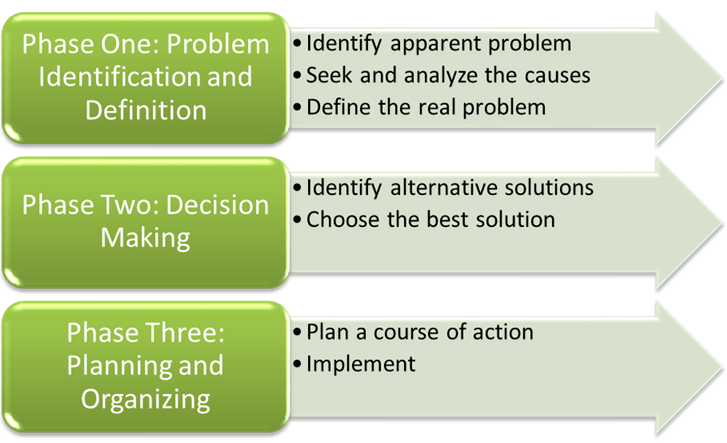
A typical problem-solving model has three phases:
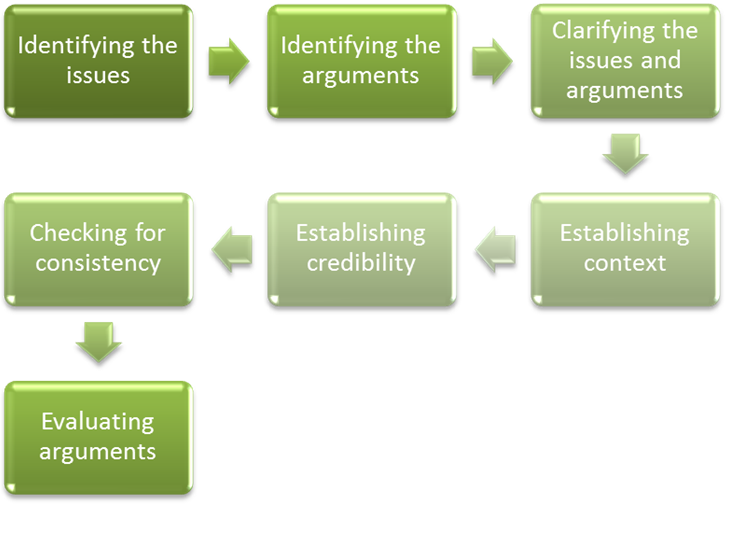
A critical thinking model has the same basic structure, but focuses on the first two phases. Here is the overall model. We’ll look at individual phases throughout the rest of the course.
The Standards of Critical Thinking
According to the Foundation for Critical Thinking (http://www.criticalthinking.org), there are seven standards that critical thinkers should have in their mindset.
Clarity
- Ask for illustrations and examples
- Get hard facts
- Ask the person to elaborate or express the idea in another way
Relevance and Significance
- How does that statement connect to the issue?
- What are the most important parts of the issue, argument, or evidence?
Logic
- Apply common sense
- Connect the dots between the points
- Ask for clarification when points clash with each other
Accuracy
- Look for supporting evidence
- Check and double-check the facts
- Get first-hand information whenever possible
Depth
- Make sure you are not over-simplifying the problem
- Are you covering all the issues?
- Are you covering the most significant issues?
Precision
- Ask for precise measurements (63% rather than “Over half the population”)
- Watch out for vague words
Breadth
- Are you looking at all the points of view?
- How could you gain more perspective?
- Look at it through someone else’s eyes (your children, your manager, etc.)
Keep these principles in mind as we work through the critical thinking model.
Identifying the Issues
Getting to the Root of the Problem
American inventor Charles Kettering once said, “A problem well stated is a problem half solved.” You need to know what issue you need to evaluate before you start evaluating it!
The first step in the critical thinking process is to ask yourself, “What is the real issue?” This can be more complicated than it seems, but it is important to get it right. Remember, an issue can be a problem, a situation, a question, or just about anything else!
Here are some tips for identifying the issue.
- Try writing it as a question that can be answered yes or no.
- Be neutral and objective.
- Review the issue statement with others involved to make sure that you have gotten to the core of the problem.
- If there are one or more issues, separate them out so that you can focus on one thing at a time.
Identifying the Arguments
Identifying Arguments
Our next task is to identify the arguments for and against an issue, and to identify the evidence supporting each argument. Ask yourself, “Why would a person take that position?” If a conclusion has already been reached, we will want to identify that as well.
Let’s continue with our earlier example. A co-worker says, “Joe quit last week because of the changes in how we schedule vacation. I guess we need to overhaul the system.”
We stated the issue as: Should we evaluate our vacation scheduling system?
One argument is yes, we should evaluate the current vacation scheduling system. Evidence for this could include facts like the number of complaints about the system from scheduling staff.
On the “no” side, you could have evidence about the phases of change, and point out that no one has had time to get comfortable with the system yet.
Case Studies
Identify a for and against point for each situation.
Situation One
- Situation: At a meeting, someone says, “E-commerce is a thing of the past. We need to start focusing on Web 2.0 applications.”
- Issue: Should we change our online strategic focus to Web 2.0 applications?
- For: _________________________________________________________________
- Against: _____________________________________________________________
Situation Two
- Situation: There is an e-mail thread circulating with a customer complaint. This customer is unhappy with the new design of your best-selling widget. Someone replies to the thread with, “We need to re-think this product design or we’re all going down the tubes.”
- Issue: Should we evaluate the current widget design?
- For: _________________________________________________________________
- Against: _____________________________________________________________
Situation Three
- Situation: One of your employees privately says to you, “Our team’s workspace is really disruptive and disorganized and it’s affecting my productivity. I want it re-arranged right away.”
- Issue: Is the current workspace configuration affecting team productivity?
- For: _________________________________________________________________
- Against: _____________________________________________________________
Clarifying the Issues and Arguments
Now, look at the issue, arguments, and evidence. Check for uncertainty and ambiguity. This can happen if:
- General words like lots, always, usually are used
- Words can have multiple meanings
- Words are in an incorrect order
Clarify the following statements.
| Unclear Statement | Revised Statement |
| Lots of employees don’t like that kind of coffee. | |
| All the big companies use the Acme 2000 printer. | |
| Our staff is poorly educated. | |
| There has been a big jump in customer complaints. | |
| Our carbon footprint has gotten bigger. | |
| These hamburgers have gotten smaller. |
Establishing Context
Now that we have a good grasp on the argument, evidence, and conclusions, let’s look at the environmental factors around them.
First, let’s explore the context of the argument. Questions you will want to ask include:
- What is the presenter’s purpose?
- Does the presenter have a personal agenda?
- Does the presenter have a relationship with you that they are trying to change?
- Are they trying to get rid of a problem?
- How was the message conveyed?
- Were others meant to hear it?
- Were they trying to distance themselves from the message? (For example, sending an e-mail rather than speaking to you face-to-face.)
- Whose turf was the message delivered on?
- What other factors are present? (Person’s status in the company, recent changes at home or work, etc.)
Checking Credibility and Consistency
Credibility
The next thing that you must evaluate is the argument and evidence’s credibility. In other words, can you believe this person or not?
Some things that you will want to find out are:
- How did the person find out the information – first hand, second hand, or beyond?
- What kind of background does the person have about the subject?
- How likely is their evidence?
- Is there other evidence, such as documents or witnesses?
- Does your background and observations support their statement?
Continuing with the example of Joe, you’d probably feel differently about your co-worker’s statement depending on whether the co-worker had spoken to Joe themselves or overheard someone else talking about it in the lunchroom.
Consistency
Finally, look through the argument for consistency. This is particularly important for formal reports, long e-mails, or complex documents. You want to look for statements that contradict each other or that are true but not relevant.